
The Art of Magnetic Conversation: Build Up, Not Out
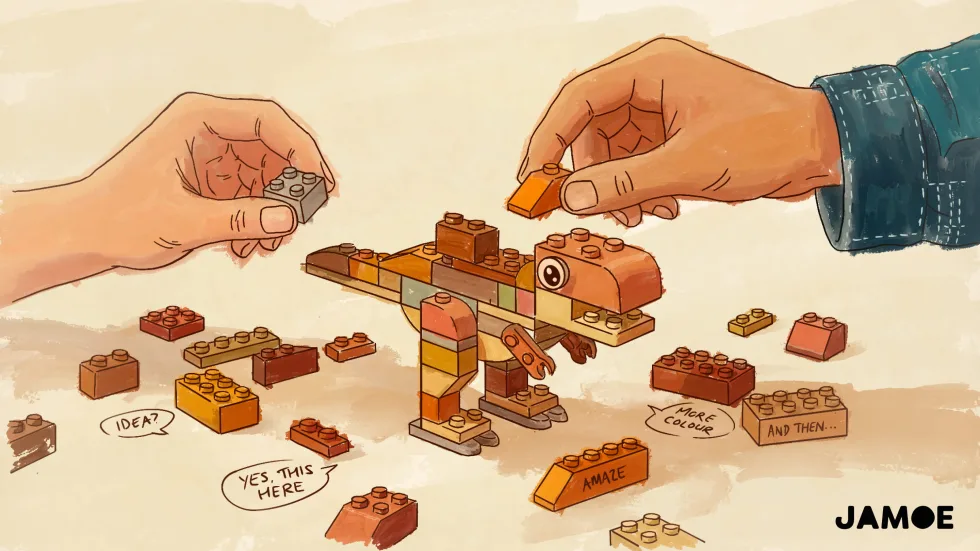
Learning to bring a conversation to life turned out to be simpler than I expected, and the insight came from an unlikely place: improv. Specifically, from realising I’d been misreading its foundational principle, ‘Yes and…’. Once I corrected my understanding, I started noticing it everywhere, especially in the people I find the most magnetic to talk to.
At a glance
Based on the reader question: what separates the people you never want to stop talking to from everyone else?
- Most people misread the improv principle ‘Yes and…’ The ‘and’ means focus on building on what’s been said rather than adding more topics to the conversation
- You don’t need to be listening to build a conversation out; you must be listening to build a conversation up
- The people you never want to stop talking to arrive present. They let the conversation show them where to go, rather than arriving with a prepared stack of topics
Introduction
Learning to bring a conversation to life turned out to be simpler than I expected, and the insight came from an unlikely place: improv.
Specifically, from realising I’d been misreading its foundational principle, ‘Yes and…’ Once I corrected my understanding, I started noticing it everywhere, especially in the people I find the most magnetic to talk to.
The fix is small. It’s a pivot in how you read the word ‘and’: not as in ‘add more topics to the conversation’, but ‘build on what’s already there.’ That one shift is the difference between satisfying conversations that go somewhere and conversations that sprawl until you’ve both forgotten what you were even talking about.
Build Up, Not Out
In the world of improv – the art of creating unscripted performances – ‘Yes and…’ means ‘accept and build.’ You accept what your partner offers and build on top of it, not outward from it.
Building up means responding directly to what’s just been said. Building out means introducing a new topic without acknowledging what came before.
Building up
A: 'I've bought some lemons.'
B: 'You're so organised. Let me give you some money.'
Building out
A: 'I've bought some lemons.'
B: 'I never loved your father.'In the first exchange, B’s reply sits directly on top of what A said. It catches the ball and throws it back. In the second, B ignores the lemon entirely and tosses a grenade. That’s most conversations, and it’s what makes them unsatisfying. They have plenty of content; nobody’s actually listening.
What Listening Feels Like
You can build a conversation out without listening. They mention cats; you bring up cars. They mention tennis; you bring up cognitive decline. The conversation keeps moving – sprawling outward, gaining surface area and losing depth – until neither of you can recall how you got there.
But you can’t build a conversation up without listening, and we come alive when someone truly listens to us. When someone engages with what we’ve said, digests its meaning, witnesses us, and senses the things we haven’t quite plucked up the courage to say yet.
That kind of listening is rare enough that when it happens, it feels like a gift. It’s also near impossible to counterfeit. The true listener isn’t just saying, ‘I’m listening’. They prove it with their response.
Brick by Brick
Think of it as collaboratively building something: each of you laying down a brick, one on top of the other, with neither of you quite knowing what you’re making until you get there.
Here’s what that looks like in practice:
A: 'I've been thinking about leaving my job.'
B: 'What's made you start thinking about it now?'
A: 'The commute, mostly. Two hours a day.'
B: 'Two hours. What do you do with it?'
A: 'I've actually started writing. On my phone, on the train.'
B: 'You're writing a novel on a cracked screen on the Jubilee Line.'
A: [Laughs] 'Something like that.'
Notice how each reply lands directly on top of the one before it. Nothing sprawls. That’s what building up looks like. The conversation is going somewhere, and you can feel the momentum building.
Like any building project, this demands your attention. If your focus slips, you can’t place your brick on theirs. You start building out rather than up and the structure starts to look like small talk.
Patterns of Poor Conversation
A few patterns I’ve noticed from some lived experience and lots of eavesdropping.
‘But I was listening’
A common defence of the lucid but self-absorbed conversationalist. You pause and point out that nothing they’ve said suggests they’ve been listening. They parry by recounting the facts:
A: 'I've bought some lemons.'
B: 'I never loved your father.'
A: 'You're not listening.'
B: 'I am. You were talking about lemons.'
B is technically correct. A was talking about lemons. But did B offer any active sign they’d heard about the lemons? No, which makes it worse. B heard what A said and chose to ignore it in favour of their own agenda. The implicit message: what you’re saying is less interesting than what I’m saying. That’s not a failure of attention. It’s a choice.
All ‘yes’, no ‘and’
If you’ve ever had a conversation that felt tiring and one-sided, this is probably why. A keeps offering material, leaving space, and keeps getting nothing back. The conversation is all ‘yes’ (all acceptance) and no ‘and’ (no building).
A: 'I bought some lemons.'
B: 'Oh, did you?' [Silence]
A: 'I'm making a tart for David's birthday.'
B: 'That's lovely.' [Silence]
A: 'David loves lemon. My son will be coming to the party, too.'
B: [Nods]
A: 'Yes, my son. He's on probation now, so he'll be out of prison.'
There are times this is exactly right. If someone needs to think aloud, holding space for them is its own kind of generosity. But done reflexively and without intention, it turns every exchange into a dead end. You leave feeling like you’ve been talking at a wall that occasionally blinks and asks for a toilet break.
What Separates the Magnetic Ones
The people you never want to stop talking to are, almost without exception, the ones who build up. They listen well enough to place their brick precisely on yours. They don’t arrive with a prepared stack of topics. They arrive present, and they let the conversation show them where to go.
The result is that you feel genuinely seen rather than simply acknowledged. And that feeling has a source. Ursula K. Le Guin wrote that ‘listening is not a reaction, it is a connection’ – and that when two people are truly present with each other, something more than an exchange takes place. ‘Words are events,’ she wrote. ‘They do things, change things. They transform both speaker and hearer; they feed energy back and forth and amplify it’1 like two pendulums swinging in tandem.*
That’s what building up produces. Not just a more satisfying conversation, but something briefly alive between two people – energy that neither of you brought to the room alone.
So the trick lies beyond charm, wit, or a repertoire of interesting things to say. It’s simpler and harder than any of them: stay present long enough to hear what the other person is actually offering, and build on that rather than whatever was already queued up in your head. It will make you a collaborator in conversation rather than someone simply waiting for their turn to speak† – or for the conversation to be over.
Build up, not out. Everything else will follow.
Footnotes
- Le Guin’s argument is that conversation isn’t a postal service: you send a parcel, I send one back. It’s something more physical: two people gradually falling into rhythm with each other, the way pendulums hung on the same wall will synchronise over time without being touched. She borrowed the physicists’ name for this, ‘mutual phase locking’: the idea that real dialogue is less a transfer of information than a physical co-regulation: two beings pulsing together rather than at odds with one another. ↩︎
- In the world of improv, we have a name for people who insert themselves into scenes regardless of the situation: they’re suffering from an overdose of vitamin Me. As in, ‘I know what this scene needs: me!‘ ↩︎
1 source
- From ‘Telling Is Listening’, collected in ‘The Wave in the Mind’ (2004). ↩︎
The End