
At a glance
- Based on the reader questions: Whenever I try to sleep, my mind decides to start solving problems and listing all the things I have to do tomorrow. When I wake up, all that energy is gone and I struggle to get started. Any advice? – Alicia, Spain
- With a pen, some paper, and our five-minute technique, you’ll be able to reduce any sleeplessness caused by a busy or anxious mind and procrastinate less come the morning.
- Understand the relationship between anxiety and mental load, and how writing a to-do list before sleeping helps to off-load any mental buzz per the insights from the polysomnographic sleep study by Baylor University.
- This technique isn't for those suffering from jet lag, but we wish you luck.
Introduction
It’s easier to put slippers on than carpet the whole world. In that spirit, we’d like to share our Evening Pages technique. With it, you'll be able to avoid procrastinating and sleep more soundly, even if you’re spinning a lot of plates. All you need is a pen and some paper.
The sleep study by Baylor University caught our eye as it focuses on improving sleep by changing internal rather than external factors[1]. Most of us have adjusted our bedrooms to be as dark and as cosy as can be, but sleep can still elude us. That’s common. One of the greatest causes of a restless night is worry and rumination. That is, having so many thoughts buzzing about that you can’t switch off. Our 24-hour notification society is the obvious cause, though it may be that you’re just having a busy week.
Fortunately, by adopting the technique of writing a to-do list before sleeping, subjects in the study consistently calmed their minds, with some falling asleep within ten minutes.
Even if sleep comes easy for you, this is still an elegant trick to have in your back pocket and can be summed up in a few steps. Plus, it doubles as a way to overcome the greatest hurdle to being productive when the sunrises and the birds start singing: getting started.
We’ll take a look at the steps involved first and then unpack the science behind the technique.
The Evening Pages technique in a nutshell
Just before you pop off to sleep, carve out five minutes to do the following. Once done, don’t do anything but sleep. The technique’s benefit comes from off-loading what’s on your mind, so reloading it with a textbook, social media, or emails will have an undoing effect:
- Using a pen and paper, write down everything on tomorrow’s to-do list: the more items, the better.
- Once done, prioritise the top five tasks by numbering them 1 - 5. No need to be too scientific. Just follow your instincts.
- That’s it. Go to slee...
- In the morning, review your list, check the priority order, and make any adjustments. Once you’ve refocused, you can get started.
It’s a simple but powerful way to calm a busy mind, get a good night’s sleep and start the day faster by carrying forward yesterday’s momentum.
With it, we’ve found we can switch off and on easier.
A practical example of Evening Pages
We use Jump Notes (our twist on mind mapping) to complete our Evening Pages. As we’re thinking fast, it’s an efficient note-taking technique to sketch out our to-dos and draw connections between related tasks.

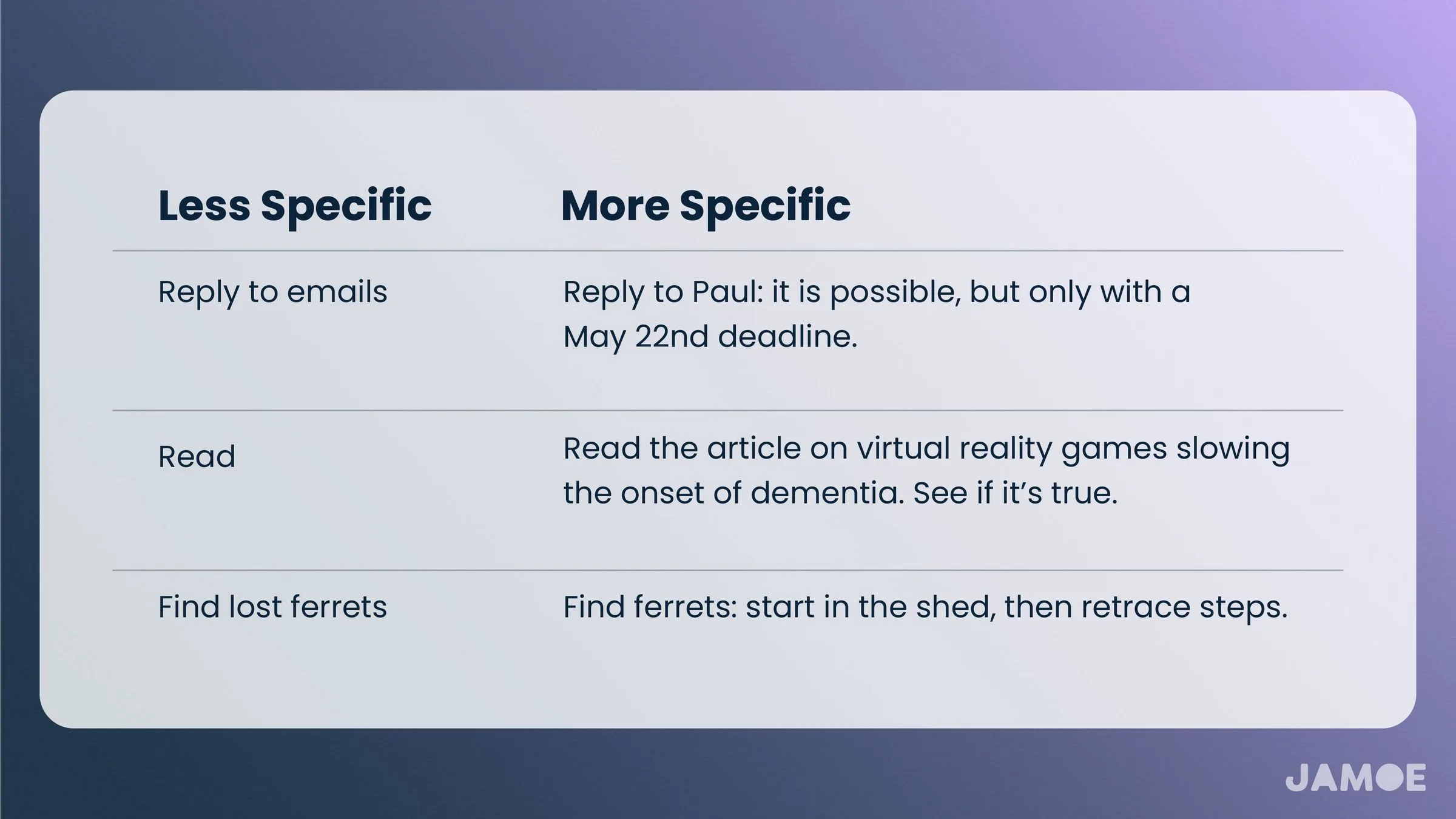
The more specific, the better
A point on best practice, the more specific, the better. As found in the study, the more to-dos and details you write, the more you’re off-loading from your consciousness, and the greater your resulting sense of calm will be. More mental calm, per the study, correlates with falling asleep faster.
You don’t need to write down every step, just enough to answer the question ‘Where do I start?’, letting future-you jump straight into getting things done.
The five-night challenge
Some people find the technique works immediately, while others need a settling in period. That’s normal. If you fancy giving it a go, try it for five nights and see if you find nodding off easier.
Unpacking the science
How do you know if someone has fallen asleep? Most sleep studies use self-reporting with questions like, ‘How do you rate the quality of last night’s sleep?’.
It’s not inherently terrible, especially if you aim to understand someone’s subjective experience, as is the case for much of psychology. However, when investigating factors that affect how fast someone falls asleep (sleep latency), self-reporting leaves a lot to be desired.
That’s why Baylor University’s study is so fascinating. Unlike most experiments of their kind, they ditched self-reporting favouring the gold standard for their area of research, a polysomnographic study.
Imagine having your brain activity, heart rate, eye movement, blood oxygen levels, and airflow monitored while you snooze. That’s a polysomnographic study. The cherry on top was that the researchers also put the subjects in sleep laboratory bedrooms that included discrete infrared cameras to monitor the subjects’ movements while they were sleeping. The result: the second you nod off, they’ll know.
For the study, there were two groups, both with assigned tasks to reduce any placebo effect. Group A was told to write down all of the tasks they’d completed that day. Group B was told to write down all the tasks that they had to do tomorrow. What surprised the researchers was what happened to Group A. Take a look at the data they gathered.
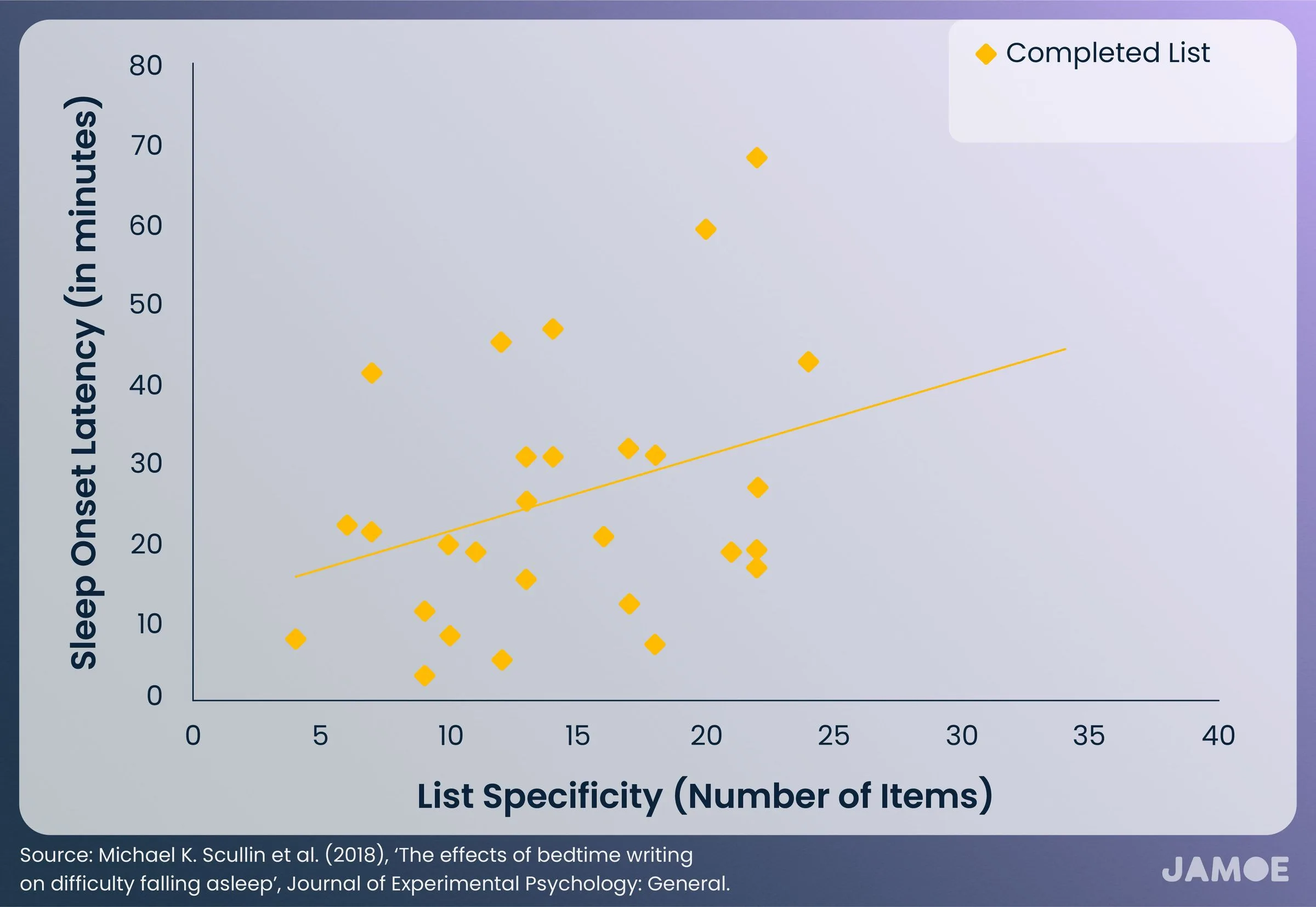
The more tasks the participants in Group A wrote down, the longer it took for them to fall asleep. The researchers theorised this happened because the subjects were inadvertently increasing their mental loads, that is, the number of things they were thinking about. The higher one's mental load, the harder it is to doze off.
By writing down everything they got done that day, the subjects in Group A reported that it stirred them to start planning all the next steps, which they weren’t allowed to write down for the purposes of the experiment.[2]
However, Group B reported they were thinking of ‘nothing at all’ after completing their to-do lists, which seems to be the key to falling asleep, as they left Group A in the dust. Take a look at the results to see the difference:
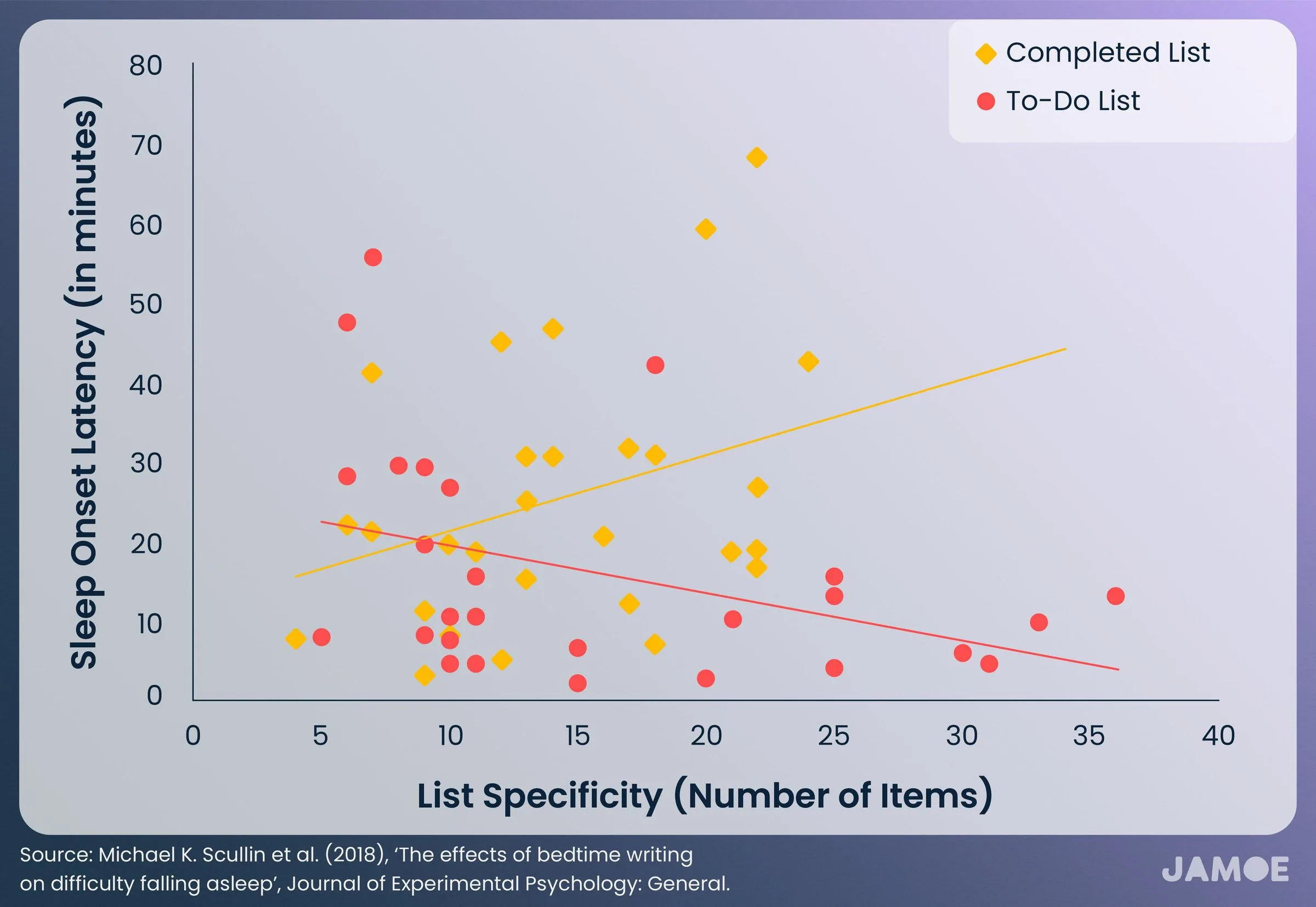
Whether you adopt the Evening Pages technique or not, the principle revealed by the study will help you exert more control over mentally switching off and on, and make the most of your mind:
- Switching off: off-loading what you’re thinking by writing it down will calm your mind.
- Switching on: reloading your mind with things that will stir up your thoughts will leave your mind buzzing.
Conclusion
Being able to switch off and on with ease is an underrated skill. Finding ways to make it effortless allows us to recharge and restart on our own terms. The trend in the literature suggests that a lot of this depends on something within our control: what we leave in our working memories.
Looking at things through this lens may help explain why people tend to fall asleep so easily listening to stories, films, or the sound of waves breaking against the seashore. These things occupy our attention and distract us from our mind’s buzz. We start thinking about 'nothing at all' and then, in the space of a blink, we're out.
Footnotes
[1] We owe the basis of this technique and a great deal of gratitude to the researchers at Baylor University, and their work on The Effects of Bedtime Writing on Difficulty Falling Asleep (Journal of Experimental Psychology, 2018).
[2] Group A's writing before bed made falling asleep harder, which shows that not all forms of journalling are beneficial. If you're looking for a digest of the best techniques to support your emotional and mental hygiene, and which ones to avoid, we recommend Opening Up by Writing It Down by Pennebaker and Smyth, two of the world leaders in writing as therapy.