At a glance
- Based on the question: Is there a sane way to decide what to keep, cut, and delegate when I’m burnt out and everything feels like too much?
- By mapping your life into a simple Energy/Money matrix, you can see which habits and tasks to protect, prioritise, delete, or delegate.
- The framework helps you defend what sustains you, drop what quietly bleeds you dry, and reshape work so your limited capacity is spent where it actually matters.
Introduction
Most advice about productivity quietly assumes you have plenty of energy and not enough time. It shouts ‘swim harder’ when you’ve already swallowed half the pool and is blind to the exhaustion you feel after years of standing up only to get knocked down again.
In this state, the issue is not that you’ve mismanaged your time, but that your nervous system is fried and your capacity has been hacked to a stump.
A common misstep during these tough times is to use the classic Important/Urgent prioritisation matrix.
However, during these frayed times, I’ve found it more helpful to think about things in terms of Energy/Money. With this alternative mapping, you’ll be able to see what to prioritise, delete, delegate, automate, and, most crucially, protect.
I’ve used this framework to find a way back into life after burning out. When I’ve stood in a home that smelled like grief and neglect and had barely enough energy to lie down.
During more stable times, the framework’s usefulness persists. It’s helped me to see the tasks that allow me endure, recharge, and find the faith that if I get bombed again by tragedy, I’ll be able to stand up again.
The Energy/Money Matrix
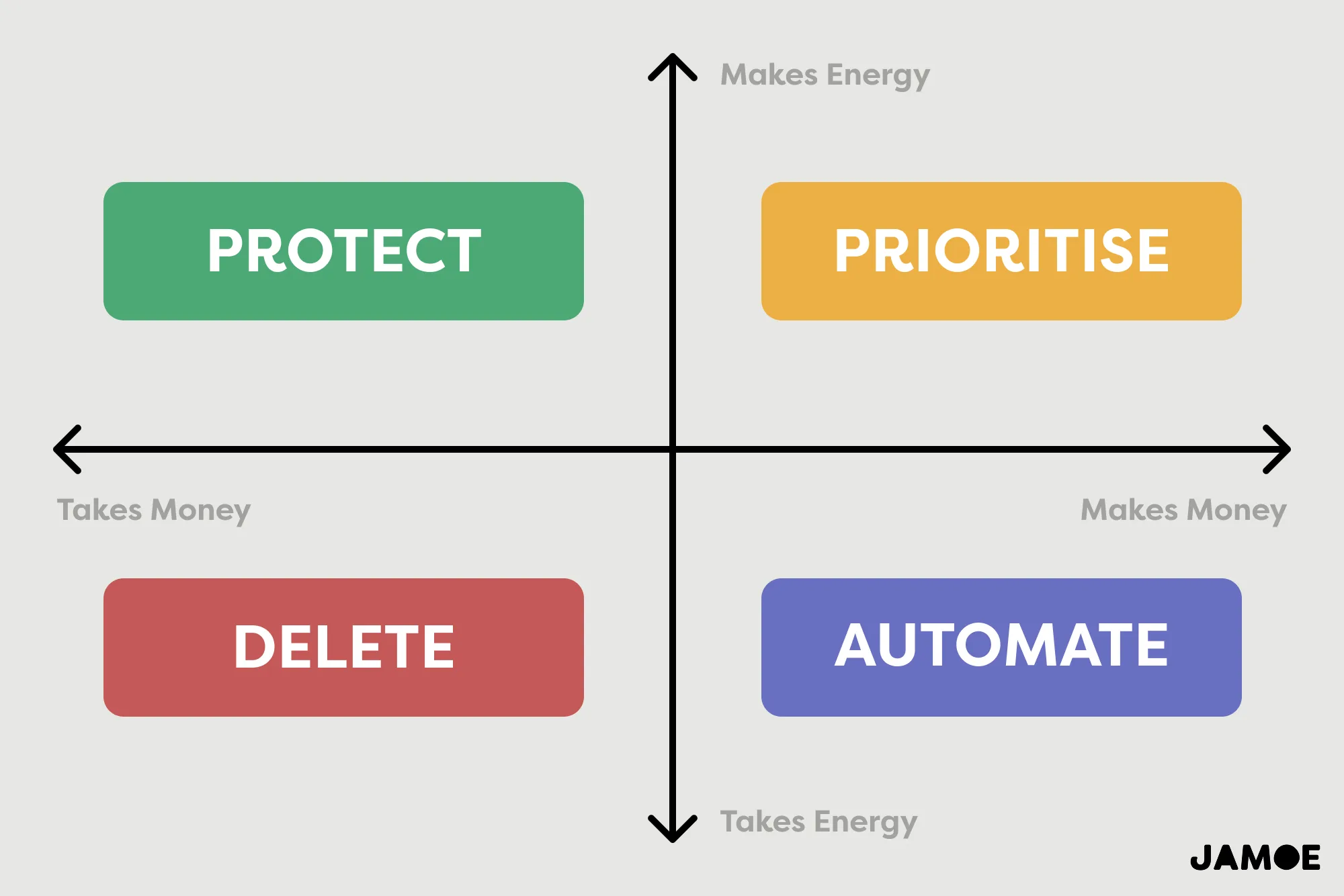
The matrix is a simple 2x2 grid. Takes Money and Makes Money runs from left to right, respectively. Makes Energy and Takes Energy then runs up and down, respectively.
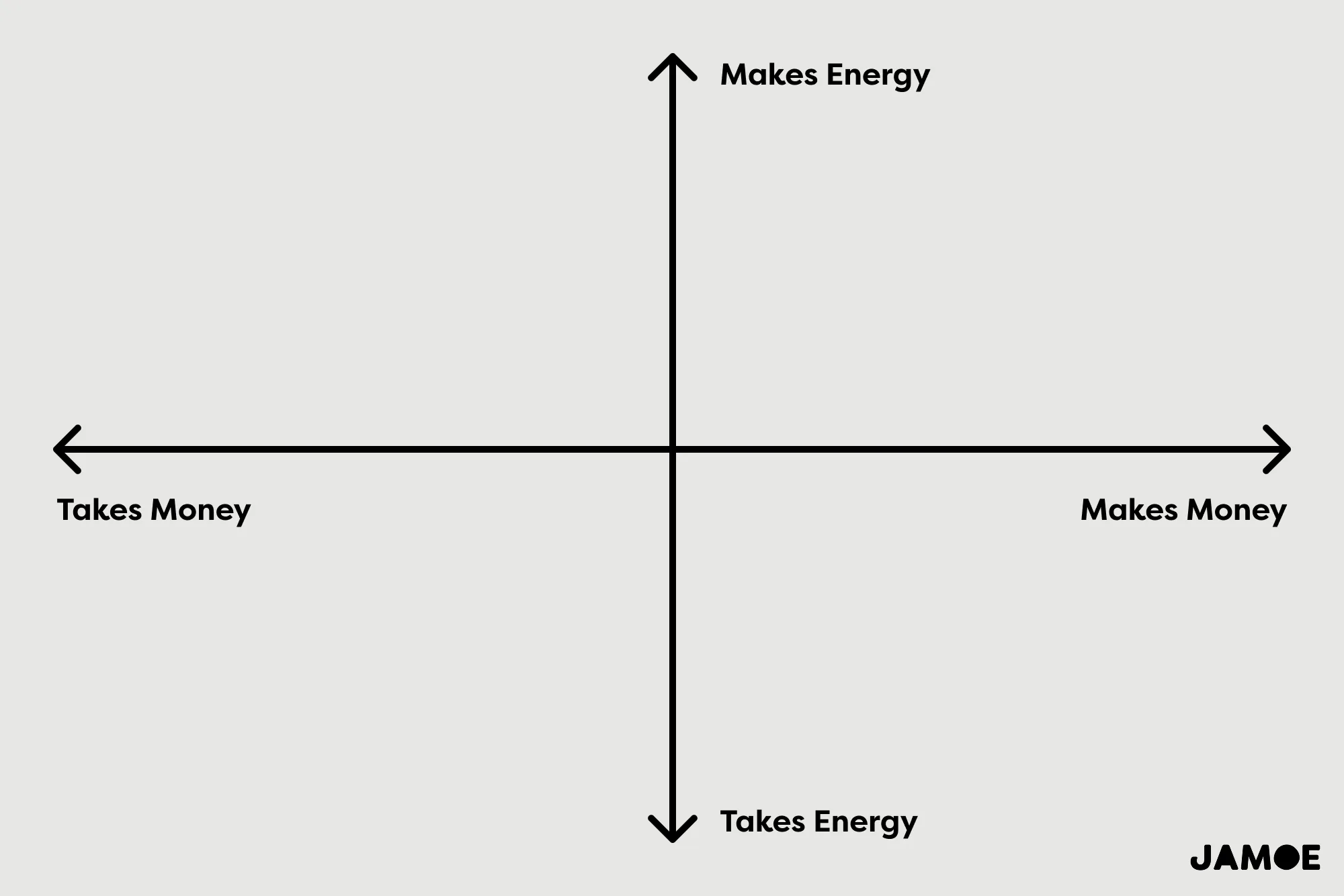
You’re habits and tasks then fall into one of the four quadrants:
- Protect: Takes money + Makes energy
- Prioritise: Makes money + Makes energy
- Delete: Takes money + Takes energy
- Delegate/Automate: Makes money + Takes energy
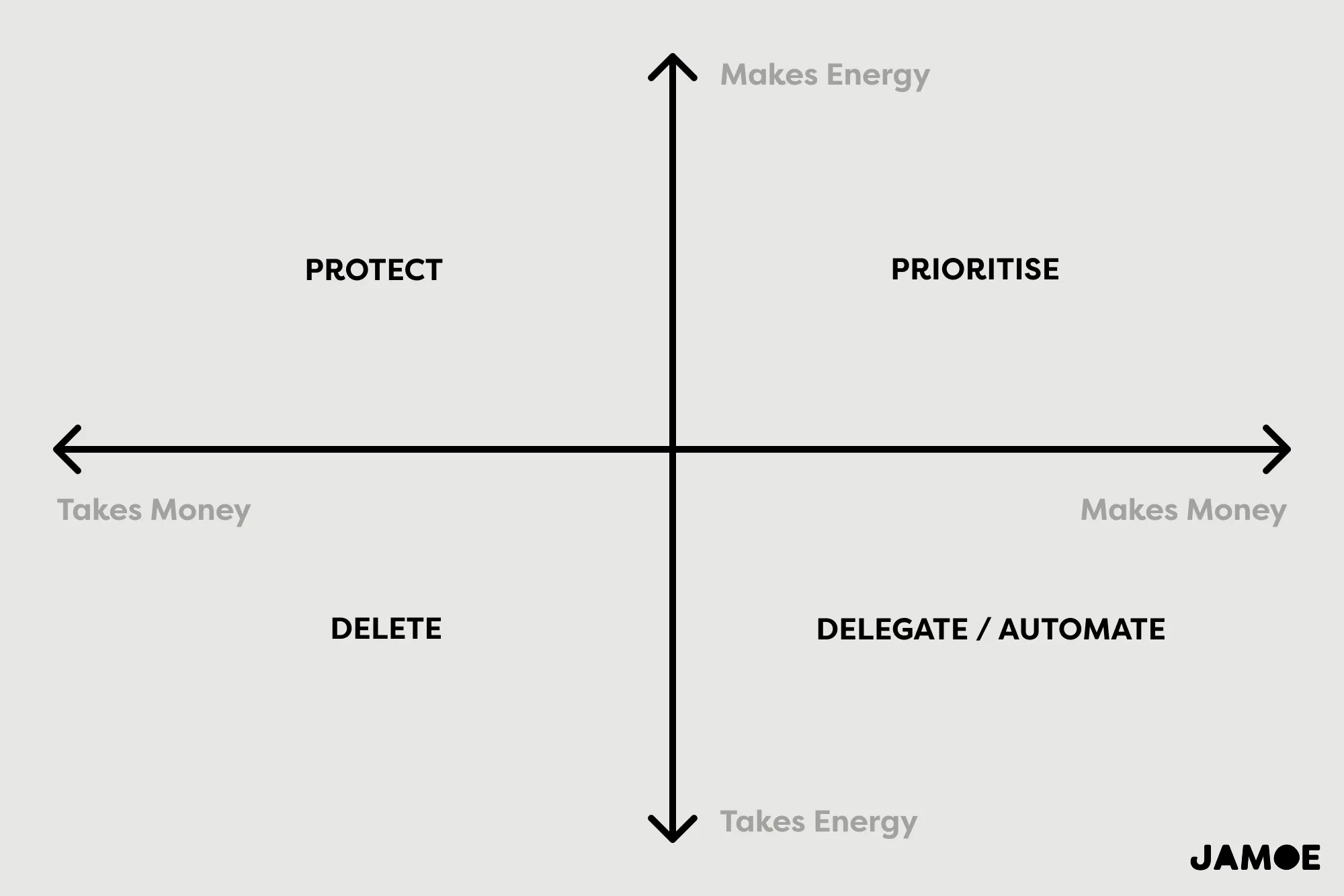
You now have a map that charts the habits and activities that are sustaining you, recharging you, distracting you, and selfishly bleeding you dry.
Quadrant 1: The things you must protect
This is the most important quadrant. These are the things that energise you but cost money – or time (you can think of them as equivalents).
They are your investments in self-care, play, routine, and leisurely pastimes that help you build the momentum you need to swing into tomorrow.
Together, they make us feel more alive, safe, and recharged. They put arrows in our quivers, fill our cups, and stop our spirits and bodies from flatlining.
Voices of guilt and shame tell us to neglect the items that live in this box. These voices try to tell us that these items as unimportant and not urgent. That’s a big reason why thinking exclusively in terms of urgency and importance is misguided. It compels us to divest in the things that keep us going.
‘Why are you eating?’
Eating is my favourite anchoring example to explain what goes in the Protect bucket because it’s so controversial.
The disgust and complaints I’ve received from managers for blocking a reasonable amount of time for ‘Lunch’ are absurd. I have lived the alternative. People will cram your calendar with their meetings with no consideration for your need for food.
Even prisoners get a recess for lunch, but taking the time to feed yourself in the workplace is too often viewed as a sign of decadence, laziness, and psychosis. Do not yield to their attempts to guilt-trip you. I assure you. They are the mad ones.
More guiding examples
With food as our anchor, here are a few more examples of things that are nourishing in the broader sense but are often overlooked or undermined:
- Creative: reading, pottery, watching films, singing, amateur dramatics, repairing a broken watch, dancing without shame.
- Somatic: walking without a destination, sleeping enough, lying on the floor, grooming, having a long shower, feeding a squirrel, feeding yourself.
- Boundary setting: turning your phone off, being strict about working hours, disabling read receipts.
- Routine: preparing breakfast in advance, packing our bag, laying out our clothes, setting out our medication.
- Fancy: getting an artisan coffee, cooking an extra colourful meal, getting dressed up for yourself.
From the list, you can see that these items are our retreats and refuges away from the pressures to hustle and perform. Together, they help us build momentum.
Do not cut here
In the tougher seasons of life, this is the quadrant people sacrifice first. Walks are replaced with swiping and scrolling. Food becomes whatever requires the least washing up. Reading is seen as a childish indulgence.
On paper, this looks frugal. In practice, it’s like saving money on electricity by sitting in the dark and wondering why you keep stubbing your toe on the furniture.
Remember to treat these items the way you would treat medicine or paying rent. They are not rewards for having your life together. They are part of what keeps you capable of living at all.
Quadrant 2: The things to prioritise (when working)
This is magic quadrant: the work that pays and puts a spring in your step:
- An email from a client that makes you smile rather than drops your stomach.
- A sort of work that draws on your strengths rather than your anxieties.
- A project that takes effort, but leaves you feeling accomplished and prideful.
If you’ve experienced a long period of trying to survive, this quadrant might look thin. As you regain your spirit by focusing on items in the Protect quadrant, you’ll rediscover the items that both spark joy and put money in the bank.
When you start noticing the items in this list, take note. With time, try to bend your time towards this quadrant. With time, you’ll build a reputation as the go-to person for this sort of work.
Quadrant 3: The things to delete
These are the vampiric and parasitic parts of our lives. Like barnacles on the hull of a ship, they often build up over time and weigh us down. We have to port every so often and chisel them off, so we can enjoy a life with more freedom.
Use the quadrant to inspect your life with fresh eyes. You’ll then be able to see the things (or people) you’re better off without.
Typical residences include:
- Subscriptions you forgot to cancel
- Apps and tools that you ‘might need one day’ but never open
- Standing social engagement that you dread beforehand and resent afterwards
- Projects that you sustain because you’re too embarrassed to say, ‘I’ve changed my mind’
- Habits that give you short-term pleasure but drain your long-term happiness
In theory, this is the easiest quadrant to deal with. In reality, I’ve found people cling to its contents out of habit, guilt, or superstition.
- ‘If I cancel the subscription to the software I barely use, I am officially giving up on being the sort of person who uses it.’
- ‘If I end this relationship, I will have to accept the troubles that come with being single.’
- ‘If I stop drinking alcohol, I’ll have to learn to be confident when sober.’
Of course, these voices are pessimistic. They ignore the upside of redirecting your efforts to the more fulfilling parts of your life.
If you can’t delete something entirely, I recommend shrinking it incrementally. For example, if you want to change your relationship with alcohol, try to have one less drink or alternate when you drink at a social occassion and when you don’t.
Once you feel the upside of tapering these leaks, you’ll be more motivated to cut them out completely.
Quadrant 4: The things to delegate and automate
These are the tedious, repetitive, mind-numbing tasks that are draining you:
- Administrative tasks that fall outside of your expertise, like accounting or design work.
- Proofreading a text for basic spelling and grammar oversights.
- Getting up to turn the light off when you’re cosy and warm in bed.
The great leaps in human progress tend to happen when we have fewer things to think about. When we’ve freed up headspace to attend to more impactful things.
I’m sure your imagination can think of more relevant examples. Where I can help, however, is in pointing out the two most common struggles people face that prevent them from delegating or automating: quality and control.
Quality and control
The two struggles people face when delegating and automating are either about maintaining quality or clinging to a feeling of control. Both are holding you back.
On the topic of quality, we often fear that if we give the task to someone else, they won’t do it to the standard we want. Assuming that’s true, you have to judge whether, on balance, you will be able to turn your attention to more impactful work if the task at hand is given to someone else.
When hiring and delegating, I use the 80% rule: if the person I’m delegating to can complete the task at least 80% as well as me, then delegating it is worthwhile.
In contrast, you have a control problem if you refuse to delegate a task to someone else when you know they could do it better than you. You don’t want to let go. That might be because your pride insists you must power everything, or perhaps you’ve learned to mistrust others.
The world of affordable contractors, employees, macros, and now AI is there to lend you a helping hand. I encourage you to give them a go.
The Quiet Point of the Matrix
Underneath all of this is a refusal to play along with a lie: that if you were a better person, you would be coping better.
You are not a moral failure because your flat is messy, your inbox is a jungle, and you can’t remember the last time you cooked properly. You’ve simply had your capacity cut down by events that would have cut down anyone.
The Money/Energy matrix can help you find the right direction again by looking at life’s labours and loves through a more constructive lens:
- These things cost me but keep me going. I will protect them.
- These things cost me and return nothing. I will delete them.
- These things pay me and don’t poison me. I will prioritise them.
- These things pay me but drain me. I will find a way for someone or something else to carry more of that weight.
With each step, you may look back at the day gone by and feel that things are fractionally less impossible. That’s a revolution worth celebrating.