At a glance
Based on the reader question: 'I want to write something funny and sharp about the world. Where do I start?'
- Satire is your friend. It can be funny, but it’s mostly about making precise observations about the world where the joke is the sauce and the message is the pasta.
- Every good satirical piece starts in the same place: a target, a take, and an angle. If these are fuzzy, no amount of wit will save you.
- Once you know what you want to say, you can reach for the nine ‘funny filters’ to flavour your message: irony, character, shock, hyperbole, reference, madcap, parody, analogy, and misplaced focus.
Note: This article grew out of a satire writing workshop with a former head writer at The Onion. Where a specific idea comes from that workshop or Scott Dikkers’ ‘funny filters’ framework, it is credited. The piece also includes some adult humour; proceed accordingly.
Introduction
Humour is never just decoration; it's how the knife gets in.
Satire is about delivering a message that draws attention to something silly, foolish, or monstrous that you believe should be challenged and changed. Comedic devices like irony, exaggeration, and shock are ways of packaging that message so it hooks, connects, and stays in the reader’s head.
Being memorable is also dangerous. Through satire, you can make a thought-provoking challenge to the status quo, which is why the powerful so often try to control, buy, or silence satirists.
Whether your goal is to be more engaging, invoke change, or both, let’s get into how to write something sharp and funny about the world: a piece for your newsletter, an article for a satirical publication, or a few hard hitters for your wedding speech.
We’ll look at how satire works, the common missteps that break it, and a workflow for producing fresh material inspired by The Onion, the long-running US satirical newspaper. They're home to headlines like:
- 'CIA Realises It’s Been Using Black Highlighters All These Years'
- 'World Death Rate Holding Steady At 100 Percent'
- 'L’Oreal Suspends Production Of Irresistible 2-Step Lip Color Stick After Lab Rat Seduces Way Out Of Facility'
By the end, you’ll have a process for creating your own headlines and a starting point for turning the best of them into full pieces.
Horatian or Juvenalian: The two types of satire
Satire has two broad camps. Which one you choose depends on how hard you want to hit. One is playful; the other aims to draw blood.
- Horatian: the gentle form of satire. There’s warmth behind the words, like a best man speech, light comedy night, or work Christmas party. The speaker isn’t looking to change anything; they’re mostly having fun.
- Juvenalian: the hard-edged form. Think Last Week Tonight by John Oliver, Borat, or The Onion. The message aims to criticise, shame, or push against perceived injustice. That cause sees the comedy turn dark, go for the jugular, and leave a mark.
The labels come from two ancient Roman satirists. Horace wrote light, wry verse poking fun at the foibles of his day; Juvenal wrote with more rage, attacking corruption and hypocrisy in public life.
Most pieces sit somewhere between the two, but asking yourself ‘Is this more Horatian or more Juvenalian?’ is useful for deciding the tone.
Neither is inherently better, but they do require different tools and serve different purposes.
Horatian satire is better when:
- You want broad appeal and don’t want to alienate readers who might be sympathetic to your target, like when hosting a bingo night, speaking at a funeral, or bantering at work.
- The flaw you are pointing at is universal (we all do this stupid thing) rather than concentrated in a powerful group. Michael McIntyre is excellent at this1.
- The piece lives on a platform where controversy would do more harm than good at getting your point across, like a school website, knitting forum, or maths textbook.
Juvenalian satire is better when:
- You are genuinely angry and believe something specific needs to change
- Your target is powerful enough to absorb the blow
- The softened version would let your target off the hook, treating what their actions are as a ‘little naughty’ rather than evil.
The key discipline with Juvenalian satire – and where most beginners go wrong – is making sure you are still hitting your target. The darkness should illuminate rather than just shock. If the piece is harsh and your reader is not certain who or what is being criticised, you’ve missed and likely hit some innocent in the process.
The Target, Take, and Angle Architecture
The target is who you want to hit, the take is what you want to hit them with, and the angle is the point of view you’re firing from.
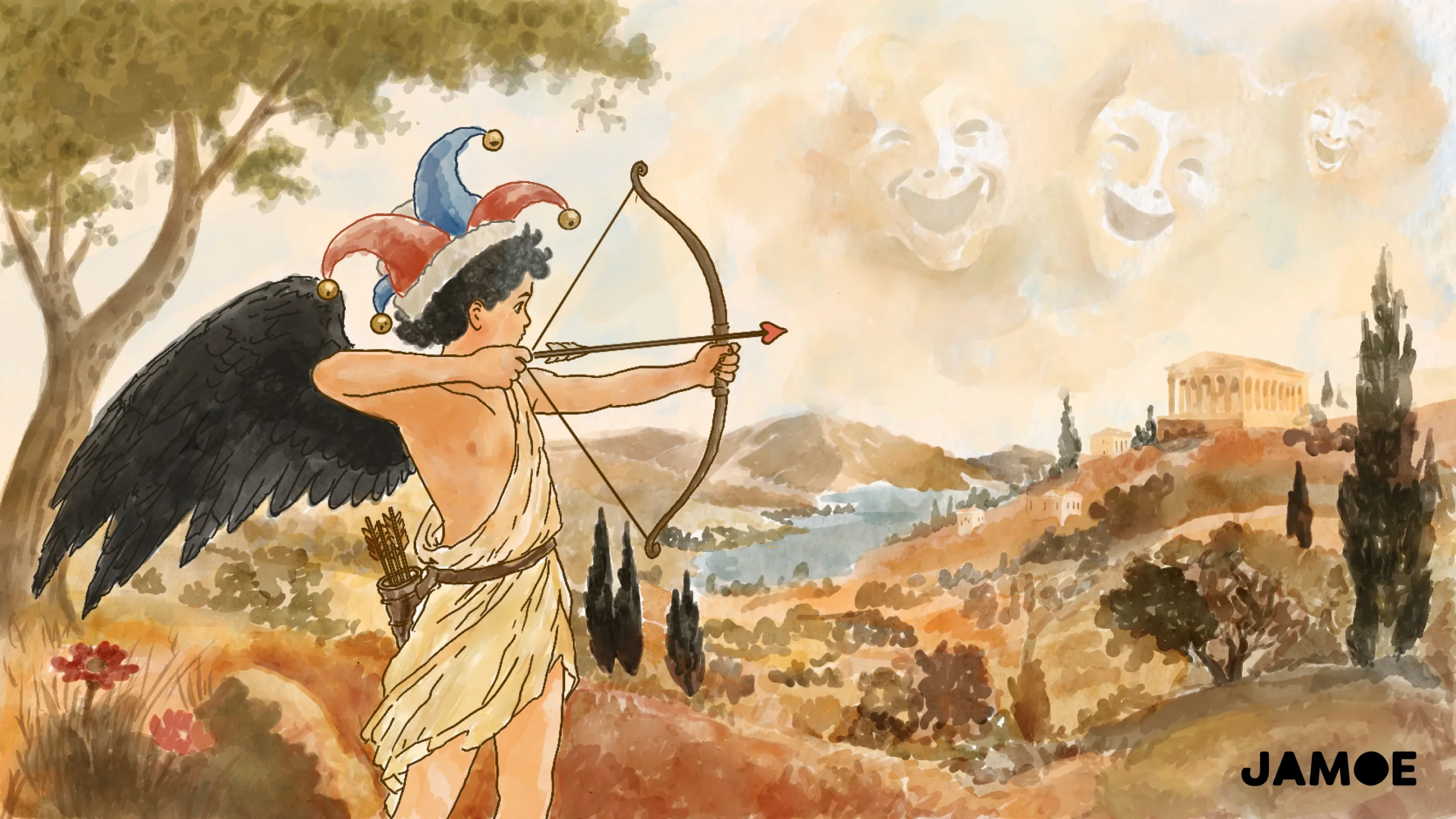
You can think of yourself as an archer. What kind of arrow are you firing, at whom, and from where: the tower, the barracks, the bushes? That is your take, your target, and your angle respectively.
Looking at an example from The Onion:
‘Study Finds iPhone Lowered Birth Rate’
- Target: iPhone culture and the smartphone-driven life.
- Take: smartphones are so all-consuming that they are crowding out sex, romance, and the other conditions in which people actually want to have children.
- Angle: a pseudo-scientific news report.
The Target
Satire has always had a moral logic underneath the laughs. When deciding whether it’s wise to go after someone, I love the old journalistic maxim: afflict the comfortable, comfort the afflicted.
Someone counts as comfortable if they have power. It might be political, social, cultural, institutional, economic – anything that puts them in a position that warrants scrutiny. A politician who cuts housing budgets while claiming to care about the homeless. A financial institution advising calm while presiding over chaos. A tech CEO performing empathy while driving thousands into destitution.
In contrast, someone who just lost their job, someone with no platform, someone being kicked while they’re already down are not targets. They’re victims. Satire aimed at them is bad taste at best and brutality at worst.
Breaking down some more examples from The Onion:
Comfort the afflicted
‘Study: More Americans Foregoing College In Favour Of Letting The Carnival Sort Them Out’
The American youth can find comfort in having the higher-education choices they’re facing acknowledged: crushing student debt, uncertain job markets, and no ‘proper’ pathway to follow.
Afflict the comfortable
‘OpenAI Announces Construction Of New Data Center On Top Of Sick Child’
AI and big tech are having their “world-saving” sense of self-importance stripped away, exposing the inhumanity of domination and endless growth at all costs.
Both
‘SNAP Now Requiring Recipients To Spend 80 Hours A Month In Hypoglycaemic Coma’
US citizens on food assistance (SNAP) can find comfort in having their lived experience recognised, not mocked, as they have to struggle through poverty, hunger, and punishing bureaucratic hoop-jumping.
The policymakers, who believe benefits should be earned through suffering, have their misguided belief taken to its logical conclusion, exposing the heartless stupidity of their policies.
The Take
The take is your arrow, the thing you want to hit the target with. In practice, it is your message or argument: the specific thing you believe about the target.
Writing that message down is usually the best place to start. If you cannot state in one or two sentences what you want to say, you need to think harder.
When defining your take, precision matters. ‘Politicians are bad’ is too vague; some are tolerable. ‘The breed of politician that performs concern as a substitute for accountability and action is bad’ is much better.
‘Social media is addictive’ is also too vague. ‘Social media companies have built their business model on exploiting the psychological weaknesses of humanity’ is a clearer shot.
You can, of course, point and laugh without a message, but that is mockery rather than satire. To be satire, it has to point, laugh, and mean something.
Clarity is essential both for saying something of substance and for avoiding misunderstandings. Confusion is the death of comedy: if your reader is confused, they are not laughing.
The Angle
The angle is the point of view – the perspective you’re speaking from. In stand‑up, the angle is usually the comedian’s own. In written or performed satire, you can borrow almost any point of view you like.
Say you want to critique the Prime Minister. You could write from the perspective of a constituent, their spouse or child, the Prime Minister themselves, or a specialist of some kind (psychologist, economist, historian). You can even get weirder: the family dog, the Downing Street lectern, the pair of underpants that had to sit through conference season. Running your take through these different points of view will produce different jokes; your job is to see which one makes the message feel sharp and fresh.
If your message is clear and a piece of satire still is not quite working, changing the angle is usually the quickest fix.
Examples of Takes, Targets, and Angles
Breaking down some examples using headlines from The Onion:
Dad sure knowns a lot about local weather woman
- Target: Everyday creepy men who dress up lechery as a harmless interest.
- Take: He doesn’t care about meteorology, but gawking at an attractive woman.
- Angle: The word ‘dad’ implies the perspective of children, mostly likely the dad’s own kids who have noticed the dad’s obsession, but don’t quite understand it.
Nicer shampoo tragically worth the extra money
- Target: The cost of living crisis and how even shampoo has an economic class system baked into it.
- Take: Discovering expensive shampoo really is better feels sad, because it reveals another thing you’re missing out due to the economic climate.
- Angle: The tone implies a neutral news voice that uses melodramatic language (‘tragically’) to contrast against a trivial purchase. The reader is left to supply the financial grief.
Depraved inbred community distances itself from the former-Prince Andrew
- Target: Andrew Mountbatten-Windsor.
- Take: Andrew is so toxic that even a grotesque institution feels the need to publicly disown him.
- Angle: A faux‑objective new report on a ‘community’.
Authorities unearth mass grave of Trump advisors
- Target: Trump and his political ecosystem.
- Take: Working for Trump is so ruinous that advisers are chewed up and discarded to avoid the disclosure of any criminal and unethical wrongdoing.
- Angle: A deadpan crime‑scene news report treating staff turnover as literal death.
Doctors say digging own grave keeps bones heathy after menopause
- Target: Medical and cultural attitudes that treat post‑menopausal women as expendable.
- Take: The system is so indifferent to older women that the only ‘health advice’ left is to prepare for death and frame it as wellness.
- Angle: Cheerful health‑news item about bone density that never acknowledges the horror of telling women to dig their own graves.
The Writing Process
The workflow Andy Miara shared from his time at The Onion was a useful way of stripping ego and fear out of the writing, so you can focus on actually making things. What follows is that foundation, with a few of my own tweaks.
The process is designed for a roomful of people drafting satirical news headlines together, but it ports neatly to solo work or other formats, like a best man speech. At the end, I’ll suggest how to adapt it beyond fake news copy.
The Onion-inspired headline writing workflow
- News items: Start by listing a few recent news items, e.g. Eurovision was boycotted by a record number of countries, David Attenborough turns 100, the rat population in Edinburgh has been surging, UK water companies have been dumping sewage in rivers and lakes. The stories can be local or global. If you’re stuck, open a news site and jot down whatever catches your eye.
- Priming: Before you write, read some existing satire to tune your ear: headlines you’ve already written, or a quick skim of sites like The Onion, Private Eye, or The Daily Mash. It’ll put your mind into the right register.
- 20-minutes of volume: set a 20-minute timer and write as many headlines as you can. Focus on quantity over quality. If you stall, return to the headlines you shortlisted in step one and consider the Target, Take, Angle. Do you want to afflict the comfortable or comfort the afflicted? News of a super-yachting incident might push you towards ‘afflict the comfortable’ and a line like, ‘Anything bad that happens to you on a private yacht serves you right, Britain has agreed’. (That one is from The Daily Mash)
- Experimenting with Angles: once you have a take and target, play with the angle. In the yachting example above, the angle is the British public. How does it change if Mother Nature is speaking? Maybe: ‘Mother Nature defends drowning twelve billionaires in yachting incident: “I was simply maximising shareholder value”’. Play with different angles and let them inspire you. Feel free to make them odd. What about the seabed or a loitering seagull?
- Anonymous sharing: In the workshop, when the timer buzzed we each shortlisted our best lines and dropped them anonymously into a shared document. We then added our names next to any headline that made us laugh. Stripping away ownership made everyone braver and less precious. As Andy put it, at The Onion the important thing is that a funny idea exists, not who thought of it. Whether one person has a hot day or the votes spread evenly matters less than hitting the day’s editorial target. For me, the surprise was that the headlines I dashed off did best, while the ones I laboured over were ignored.
- Advocating: After the votes were cast, we did the final step: defending our top picks and pitching how we’d turn them into full articles. The pleasing twist was that we were now arguing for headlines we hadn’t written; our only stake was that they felt playful and shiny enough to explore. It was a relief to stop defending our own work and our right to be there, and just champion whatever was the funniest ideas in the room.
Some UK-leaning headlines that emerged from the workshop:
- Clavicular Cuts Off Nose To Spite His Face
- Gorillas Worried Who Will Narrate Their Lives As Attenborough Turns 100
- Water Companies Launch Free Immersive Cholera Experience For Local Villagers
- Toilet Paper Shareholders ‘Have A Good Feeling’ About Hantavirus
- Cows Outraged Over Anti‑Mooing Technology At The Eurovision Final
- Keir Starmer Hasn’t Noticed It’s Time To Leave, Despite Voters Sighing, Slapping Thighs, And Saying ‘Right’
Applying the workflow to other forms of writing
When you drag this workflow into other kinds of writing – a best man speech, a short story, a leaving‑do toast – the Take, Target, Angle framework still works.
Most of us have a few beats we know we want to hit long before there is anything resembling a finished draft. That’s the take. In a best man speech, the main target is the groom. Your takes might be his zealous use of hair gel, the time he got lost in IKEA, or the way his voice goes up an octave whenever he sees a squirrel. Get those down as boring bullet points you can prettify later.
Once the raw material is on the page, you can start to tilt it. The IKEA story, for example, can wear different ‘funny filters’. As hyperbole, it becomes ‘We were minutes away from filing a missing‑persons report’. As analogy, ‘Watching him navigate IKEA is like watching a corgi do a tax return’. As soft irony, ‘This is the man responsible for delivering complex projects at work’. Each one gives the take a different flavour.
This is very close to how Phoebe Waller‑Bridge (Fleabag, Killing Eve) works. She talks about starting with material – jokes, gags, odd little moments – and only worrying about structure once there is enough stuff on the table to arrange. A staggered approach like that makes the whole thing less daunting: collect the bits, experiment with angles and ‘funny filters’, then worry about ordering them.
If you want to road‑test this on your own project, try this: pick one target (say, the groom), list three takes on them you want to mention, then choose one of those takes and write three versions of it, each from a different angle or using a different comedic device. One of those nine will usually feel more alive. That’s your signal you’ve found a beat worth building upon.
Tips and tricks
There were two things from the workshop that helped me keep the focus on satire, avoid smothering the joke, and have a reliable way to start: the subtext rule, and making the bad thing good.
The subtext rule
Subtext – what you are saying underneath what you are saying – must never be stated directly. If the subtext (your take) becomes the text, the joke is over.
Take an Onion headline: ‘Taylor Swift adds additional wedding dates in L.A., Miami, Boston’. The article never spells out the point. The reader does the work, and that act of connecting the dots is where the laugh lives. Here, the dots form a picture of Swift treating even a wedding as a touring and money‑making opportunity.
If the headline added, ‘this is, of course, a demonstration of how performative and shallow she is’, the joke would vanish on contact. So, when in doubt, strip out any line that sounds like you explaining your own joke.
Make the bad thing good
A reliable way to turn a take into something comedic is to make the bad thing good, or the good thing bad. You flip the surface of a core truth and suddenly there’s more room to play.
Bad thing good
‘Environmentally conscious Gen Z swap vaping for smoking to reduce carbon footprint’
(The bad thing (smoking) has been dressed up as the good and environmentally conscious choice.)
‘Beauty blogger releases ‘Epstein concealer’ to celebrate the world’s largest cover up’
(A horrific scandal is reframed as a branding opportunity in the beauty industry.)
Good thing bad
‘David Attenborough celebrates 100th birthday by eradicating 100 species’
(A national treasure and his birthday milestone turn dark.)
‘Snowmen and women in pieces over recent British heatwave’
(Nice weather is flipped into a disaster in the eyes of the snow people.)
If you’re stuck, you can literally write this out: ‘The bad thing in this story is X. How could someone plausibly argue X is actually good?’ or ‘The good thing here is Y. Who might see Y as a nightmare?’ Often, the answer gives you a headline almost ready‑made.
To try this on your own material, pick one story or topic, write down three ‘bad things’ or ‘good things’ at its core, then for each one draft three flips: make the bad thing good, or the good thing bad, using any device you like (hyperbole, irony, analogy). Somewhere in those nine, you’ll usually find one that clicks.
Funny Filters
Scott Dikkers, who founded The Onion and spent decades stress‑testing this framework, identified a set of ‘funny filters’ for turning raw opinion into something that actually lands on the page. Good satire usually leans on more than one at a time: one filter does the heavy lifting, the others sit underneath as support.
What follows is a quick tour of the main filters and how to use them. The heavy credit for this section belongs with Dikkers and Andy Miara; all I have really done is translate their tools into a version you can drag into your own drafts. Check out Dikkers’ book, ‘How To Write Funny’ for more.
Irony
Irony shows up when the surface meaning is the opposite of the intended meaning or expectation. ‘Opposite’ is the key word.
‘Man run over and killed by ambulance’ is ironic because we expect an ambulance to save a life, not end it.
Irony works best when you deliver the opposite of your true meaning with complete conviction (playing it straight). The contrast between the surface and the subtext is where the laugh lives.
Examples (via The Onion)
- ‘It’s Not A Crack House, It’s A Crack Home’
- ‘Gay Teen Worried He Might Be Christian’
- ‘Surgeon General: Smoking Fine As Long As You Only Do It When Drunk’
Irony: Extreme opposites.
How to use: Write the polar opposite of your subtext.
Character
A comedic character is a two-dimensional figure with one to three clearly defined traits, who then acts in accordance with those traits.
A quick way of building a character is to assign an adjective to a role: stoic scientist, mad therapist, unhinged doctor, flirty barber.
‘Creepy Dad Sure Knows A Lot About Local Weather Woman.’
In this, the dad's traits (misogynist, distracted, slightly embarrassing) are established by the noun and adjective. The rest of the joke is just that character being themselves.
Good character jokes use recognisable and universal human flaws. These have the reader think ‘I know this person’ rather than ‘what is this weirdo doing?’ The familiarity brings the reader in on the joke.
Most stand‑ups use this as their core Funny Filter: they build a persona (cocky, anxious oversharer, over‑sincere hothead) then tell stories where that persona shines through.
Rodney Dangerfield’s line, ‘I don’t get no respect…’ sets his one trait, then every joke shows him living inside it: ‘I don’t get no respect at all. The other night I felt like having a drink. I said to the bartender, “Surprise me.” He showed me a naked picture of my wife’.
Examples (via The Onion)
- ‘Sperm Cells Unaware They’re Swimming Up Large Intestine’
- ‘Obama Outlines Moral, Philosophical Justification For Turkey Pardon’
- ‘Obnoxious String Theorist Can Explain Everything’
Character: A character with 1-3 clear traits.
How to use: Let the character act (or be acted upon) in line with one of those traits.
Shock
Sex, swearing, violence, prejudice, or general grossness are the darlings of shock.
The stronger the shock, the sharper the subtext needs to be. Beginners often skip the message and jump straight to saying something appealing, then complain that people ‘can’t take a joke’. Without a take, you’re not being edgy. You’re just being a knob.
Examples (via The Onion)
- ‘God Answers Prayers Of Paralysed Little Boy “No,” Says God’
- ‘Why Do All These Homosexuals Keep Sucking My Cock?’
- ‘Fun Toy Banned Because Of Three Stupid Dead Kids’
Shock: Anything shocking (sex, violence, cruelty, slurs, etc).
How to use: Sparingly, and always in service of a clear subtext. The more shocking the line, the more thoughtful the underlying point needs to be.
Hyperbole
Hyperbole is exaggeration pushed so far that it breaks the laws of physics and reason.
Rodney Dangerfield: ‘My parents didn’t like me. For bathtub toys they gave me a blender and a transistor radio’.
Examples (via The Onion)
- ‘NRA Calls For Teachers To Keep Loaded Gun Pointed At Class For Entire Day’
- ‘Planned Parenthood Opens $8 Billion Abortionplex’
Hyperbole: Exaggeration beyond the bounds of science or reason.
How to use: Take your subtext and blow it up until you’ve created a new, impossible reality that still makes emotional sense.
Reference
Reference jokes point at something the reader has lived through or noticed but perhaps never named. They’re little ‘oh, that’ moments.
Good reference jokes bind writer and reader together around the strange bits of everyday life, the way things are, or the shared defects of the human condition. You can also take a tired observation and state it in an refreshingly specific way.
Examples (via The Onion)
- ‘Family Watching Film White-Knuckles It Through Unexpected Sex Scene’
- ‘New Marijuana Study Confirms Everyone Knows You’re High’
Reference: pointing to something readers recognise in their own lives.
How to use: note your small, honest observations about daily life, culture, or human behaviour, then phrase them so the reader feels mildly exposed or seen.
Madcap
Madcap is the cartoon end of the spectrum: slapstick, whacky, and gleefully silly.
Done well, the ridiculous behaviour or image still carries a message. Without subtext, it’s just random nonsense. With subtext, it becomes a way of smuggling in a point through clowning.
Examples (via The Onion)
- ‘Secretary Of Agriculture Attends Diplomatic Meeting With Foreign Cabbage’
- ‘Meat Prices Skyrocket After Cow Smashing Machine Gets All Beefed Up’
- ‘Wheelchair-Basketball Players Stunned By Thunderous Slam Dunk’
Madcap: silly slapstick, whacky, cartoon logic.
How to use: choose a clear take, then push the physical world to behave in absurd ways that echo or heighten that take.
Parody
Parody makes fun of the way something presents itself – its style, voice, format, or mannerisms.
Verisimilitude is everything. The closer you can get to the original, the funnier the twist. During delivery, play it straight. Don’t wink at the reader.
Examples
- The Onion is a parody of traditional journalism
- SNL UK and USA often do parody-based sketches
Parody: Using another entertainment or information format’s style
How to use: Mimic the source faithfully, put the clearest reminders up front (visuals, phrases, tics), and never wink at the audience.
Analogy
Analogy is comparing two different things and finding similarities. The two things should be different, ideally opposites, but still have some similarities. Finding the similarities and making the reader aware of them is what makes an analogy funny.
The secret to using analogy well is keeping half of your analogy a secret. You only want to overtly reveal one of them to your reader. The other half is alluded to and the reader is invited to do the maths based on your clues and find the connection.
The Onion loves analogy. They often compare Congress to a school playground, a classroom; scientists to children; romantic relationships to workplace relationships; national treasures to perverts; teachers to parents; doctors to hippies. The analogy doesn’t need to be complex. It can be extremely simple and still effective.
Examples (via The Onion)
- ‘Al Gore Places Infant Son In Rocket To Escape Dying Planet’
- ‘VH1 Reality Show Bus Crashes In California Causing Major Slut Spill’
Analogy: Comparing two disparate things and finding as many links as you can.
How to use: Keep one half ‘behind the curtain’, with only clues showing; keep the other half centre stage. Each clean connection the reader spots is another laugh.
Misplaced focused
Misplaced focus uses the elephant in the room to get the laugh. You talk at length about the wrong thing, and the reader’s brain supplies the thing you’re conspicuously ignoring.
You pretend to misunderstand what matters, or care deeply about a trivial side‑issue, which draws a sharper outline around the real problem. It’s a close cousin of playing the dope: you get the wrong end of the stick while the audience seethes on your behalf.
Examples (via The Onion)
- ‘Secondhand Smoke Linked To Secondhand Coolness’
- ‘Suicide Prevention Tips To Be Included On Single Serve Microwavable Meals’
Misplaced focus: Feigned obliviousness to an obvious fact, highlighted by obsessing over something minor.
How to use: pick your subtext, then choose a much less important detail and have the piece treat that as the main concern. The reader’s frustration does the rest.
Spot The Funny Filter
As an exercise, look at the headlines I drafted below and see if you can pin down the Take, Target, and Angle. Then try labelling the dominant Funny Filter in each:
- Elon Musk Cries After German Citizen Converts Life Savings Into Rupees, Becoming World’s First Quadrillionaire
- Gym Bros Unable To Carry Shopping Due To Permanently Sore Muscles
- White House Declares Having All The Cards, Loses Uno
- Record‑Breaking GoFundMe To Fix Pavement Evangelical Smashed His Head On While Protesting Women’s Healthcare In The UK
- Fashion Influencer Outraged As Everyone Starts Dressing Like Her
- Bystander Refuses To Help Drowning Billionaires, Claiming He Doesn’t Believe In Handouts
- Seagull Ignores Drowning Billionaires’ Cries For Help: ‘They Didn’t Have Any Chips’
- Davy Jones Welcomes Billionaire Yacht Scum With Open Arms Aboard The Flying Dutchman
- Al Gore At Wits End Explaining His Name Is Al Gore Not AI Gore
- Brothel Raided After Owner Describes Culture As ‘Like A Family’