
This week, I figured out that the entire wellness supplement industry was, for most practical purposes, a very attractive wall of nothing. I did this while trying to fix my eyes. Nobody was particularly interested.
'That's such a Jamie way of eating dark chocolate.'
Martin had recognised a pattern I'd overlooked. I, over a post-comedy gig drink, had explained how I had spent February eating precisely the right amount of dark chocolate to measurably improve my mood, having reverse-engineered the optimal amount needed for the magnesium inside to outwit the foul anxiety and depression I'd been wrestling with.1
I guess that is a slightly special way of eating dark chocolate.
We laughed and toasted to my friend who had just made his stand-up comedy debut. As my friend embraced new horizons, I doubled down on old habits and thought of the next single-subject clinical trial to run on myself.
To understand my next move, you need to understand the shape of the three years that preceded it.
I had lost both my parents and grief had become my shadow. For some, grief is a sudden bang. For me, it had been more structural: a slow rearrangement of the load-bearing walls of my life, causing the kind of damage that doesn't reveal itself all at once but shows up later, when the ground subsides and the ceiling starts to crumble.
I think how your grief manifests itself depends on how you lose someone. One parent died slow. The other died fast. It was the slow, grinding years my mum spent being treated that accumulated inside me and imploded.
I had, in the language of my own private accounting, built up a self-care debt: a string of obligations to my body that I had deferred or bartered away to attend to more urgent obligations. It was, I would say, worth it. I got to squeeze in more moments showing my mum she was loved before she passed. Though all debts must be paid, and the interest rate on the debt I'd accumulated would have made a loan shark blush.
The debt paralysed me at the beginning. Reflecting on that time now, it does strike me as dumb that the brain would make you so upset that it tries to kill you with sadness. What if a jungle cat had turned up? I'd be screwed.
Though I was already pretty screwed. I only woke up to how severe things had become when I looked in the mirror and saw the contours of my ribs. Oh, yes. Food. I remember food. I was supposed to eat it...
I did figure out how to feed myself again. Though, as I carried on attending to all the neglected corners of my life, I noticed how expansive my debt was. Basically, everything was broken: my gut was a mess, my hair was falling out, and my brain had all the bite of a chihuahua.
I had been systematically paying down these debts.
The eyes, though. The eyes were the problem I couldn't seem to solve.
They had been bad for the better part of a year. Dry and inflamed each morning, as though I had been stung by a nocturnal bumble bee. On high pollen days the condition escalated: I would come inside, fall asleep, and wake at some ungodly hour wondering if someone had pepper-sprayed me in my dreams.
Not being able to figure out the root cause, I invented a little management routine involving eye drops, jumbo swimming goggles, and a vacuum cleaner.
The eye drops treated the dryness, the goggles were for chopping onions, and the vacuum cleaner was for my hair.
Whatever had happened to my eyes made cooking with onions unbearable, which was unfortunate. Most of what I cook is Indian food. Onions are everywhere. So what used to be an unpleasant sting had become a pair of screaming, red-raw eyes.
My hair was the other smuggler of pain. All the pollen from outside would collect in my hair, build up on my pillow, and crawl into my eyes and sinuses as I unwittingly breathed it in for eight hours. Enter my trusty vacuum cleaner. A quick spruce before laying my head on the pillow would dislodge any plant-based pollution on the days I wasn't washing my hair. I also needed to make sure I kept any facial hair short. Pollen loves to charm itself onto a beard.
I haven't yet figured out how to explain my eye-management routine to a future romantic interest. Perhaps I'll simply forward them this story and hope they're smitten enough to look the other way as I rustle up some dinner with my scuba-diving goggles before vacuuming my hair and retiring to the bedroom.
A few weeks ago, however, I discovered something: what was actually broken with my eyes was the oil layer.
The eye, it turns out, is not simply a wet surface exposed to the world. It's a carefully engineered system: a water layer, covered by a thin film of oil produced by glands along the eyelid margins, the whole thing designed to stay stable, resist evaporation, and absorb the continuous daily assault of pollen, dust, and the occasional shallot. When the oil layer goes, everything else follows. The water evaporates. The surface becomes reactive. Things that previously caused no discomfort become intolerable.
The glands that produce the oil are called meibomian glands. Mine had, at some point during the preceding two years, become so persistently inflamed and blocked that they had effectively stopped working. The chronic stress, the mould problem in my flat, the pollen, the grief: all of it had contributed to a systemic inflammation that had, among its many other achievements, disabled the front-line defence system of my eyes.
The fix was a warm compress. Ten minutes a day, eyes closed, applied first thing after waking.
I started on a Monday. By Thursday morning I woke up and my eyes felt like eyes. I went outside into a morning thick with pollen and felt, for the first time in over a year, nothing in particular.
The oil layer was the answer. I did some more digging and learned that upping my omega-3 intake would accelerate the healing.2
I made a list.
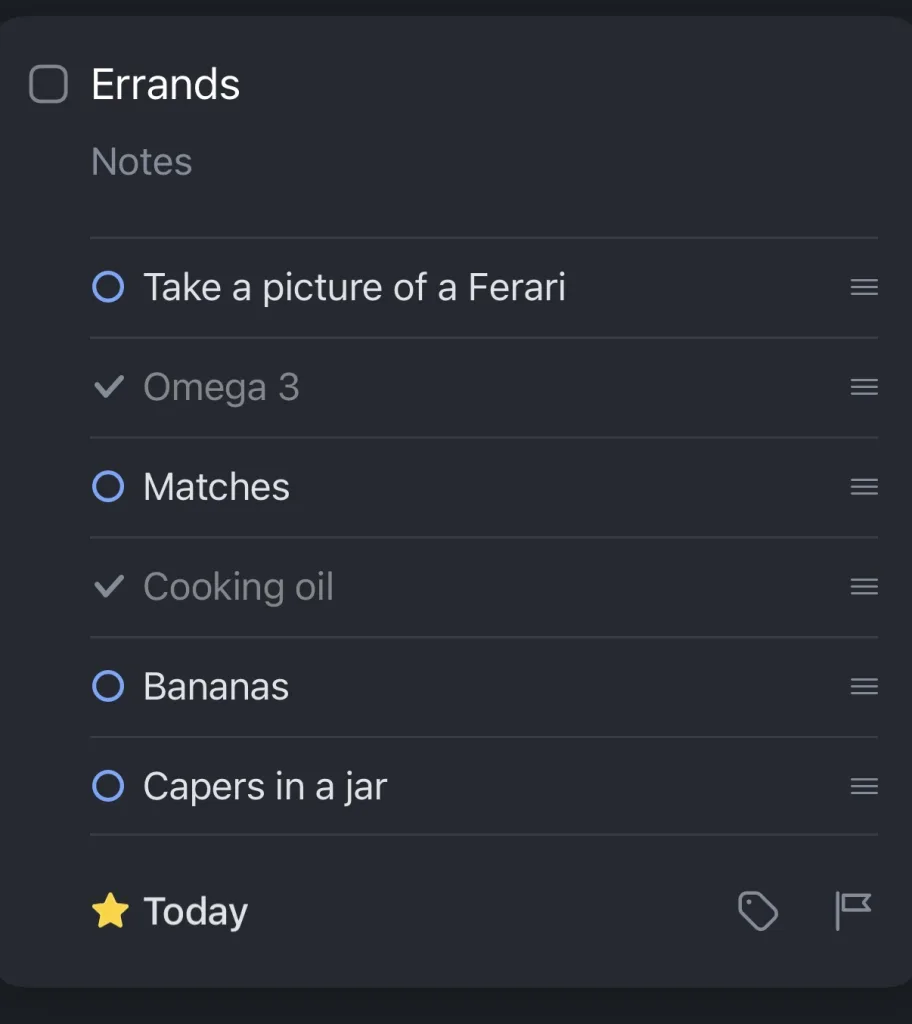
Before I get a flurry of questions, I should explain the Ferrari to-do. For that week's newsletter, I wanted to include the comforting fact that Enzo Ferrari, the founder of Ferrari, didn't sell his first car until he was 49.3 I thought a picture of one of the red supercars would be a poetic complement, even though Ferraris are one of the rarest cars to see in the wild. They make around 14,000 per year. Porsche, for context, sells that many cars in roughly a fortnight. Despite the odds not being in my favour, I thought it would be fun to make it a side-quest.
Moving on, I arrived at the supplement shop.
The supplement industry in the U.K. turns over several billion pounds a year. It is, by almost any regulatory definition, an honour system: companies are not required to prove their products work before selling them, labels are not required to reflect the actual bioavailability of the compounds inside, and the gap between what a bottle promises on the front and what it delivers in practice can be, in some cases, total. The industry knows that most consumers read the front of the label and not the back, and optimises accordingly.
I read the back.
I went in knowing exactly what I wanted: algae-based omega-3, high in DHA and EPA, the two fatty acids with the strongest clinical evidence for my specific purpose. Not flaxseed oil, which converts to DHA and EPA at a rate of roughly five to fifteen percent, making most of what you swallow functionally decorative.
What I found was a wall. Approximately fifty products, floor to ceiling, almost none of which were what they appeared to be on inspection. I went through them methodically, rotating each bottle, reading the small print, setting it back down. A sales clerk appeared and kept offering me things that were three-for-two. I kept declining. She began to look at me the way people look at someone who is, in their professional opinion, making things unnecessarily hard for themselves.
It reminded me of when I wanted to go beyond the benefits of chocolate and looked into magnesium supplements: the same wall, the same experience of realising that most of what lines these shelves was the wrong compound – specifically the one that doubles as a laxative. My thoughts went to the people who heard about magnesium's benefits on a podcast, skipped to the shops, picked up one of the misleading bottles, and spent a solid chunk of their week exploring an urgent and confusing relationship with their nearest toilet.
On the bottom shelf, tucked behind some gummies, I found my omega-3.
I paid and turned my mind to buying some banan–
Vroom.
An engine note roared with such fullness and deliberation that you felt it come up through your feet before it reached your ears. I turned.
There, pulling up to the lights with a mix of liquid grace and coiled aggression, was a Ferrari.
I stood on the pavement and stared at it the way you stare at something that shouldn't exist in your postcode.
Damn, my dad would have loved this.
He had a thing about cars, the way some people have a thing about food, coffee, or stamps: a fluency and a feeling that I never quite inherited but always enjoyed being around. I thought about the afternoon we'd spent at Silverstone, the thunder of the crowd when Hamilton came through, both of us squinting across the car park afterwards trying to spot a civilian Ferrari and coming up empty. I stood on the pavement a moment longer, thinking back to that summer. The lights changed and the car was gone.
That evening, after making dinner – onions, no goggles – vacuuming my hair, and putting on my pyjamas, I had an idea. I opened my to-do list and added a new item:
Play the National Lottery. Win the jackpot prize of £8.6 million.
My track record, at this particular moment, wasn't bad. I thought I'd try my luck.

P.S. If there's something you'd like me to add to my to-do list, send it in. I appear to be on a roll.
- High-percentage dark chocolate (over 70%) contains magnesium, which is associated with reduced anxiety, improved mood, and better sleep. The forms worth taking as a supplement are magnesium glycinate or malate; magnesium oxide, the most common variety on shelves, is poorly absorbed, largely cosmetic, and a decent laxative. You're looking at around 5–10g of dark chocolate to get a useful dose – a square or two. Dark chocolate at these levels is also rich in flavanols, known blood-flow boosters. Do with that knowledge what you will. ↩︎
- DHA and EPA, the long-chain fatty acids found in algae-based omega-3 supplements, have a well-established role in supporting meibomian gland function and reducing ocular surface inflammation. Fish obtain their omega-3 by eating algae; the algae-based supplement cuts out the middle
manfish entirely. ↩︎ - Enzo Ferrari founded the Scuderia Ferrari racing team in 1929, but didn't produce a road car under the Ferrari name until 1947, when he was 49. The company is now publicly traded on the New York Stock Exchange, worth billions, and has the best stock ticker: RACE. ↩︎