At a glance
Based on the reader question: I feel like I have a terrible memory. No matter what I try, things just don't seem to stick. Is there something wrong with me?
- ‘I have a terrible memory’ ignores the reality that our memories tend to fail in four distinct ways, each with a different cause and a different repair.
- The four failure modes are: 1) it never went in properly, 2) you only met it once, 3) the hook is weak or missing, and 4) you are simply carrying too much.
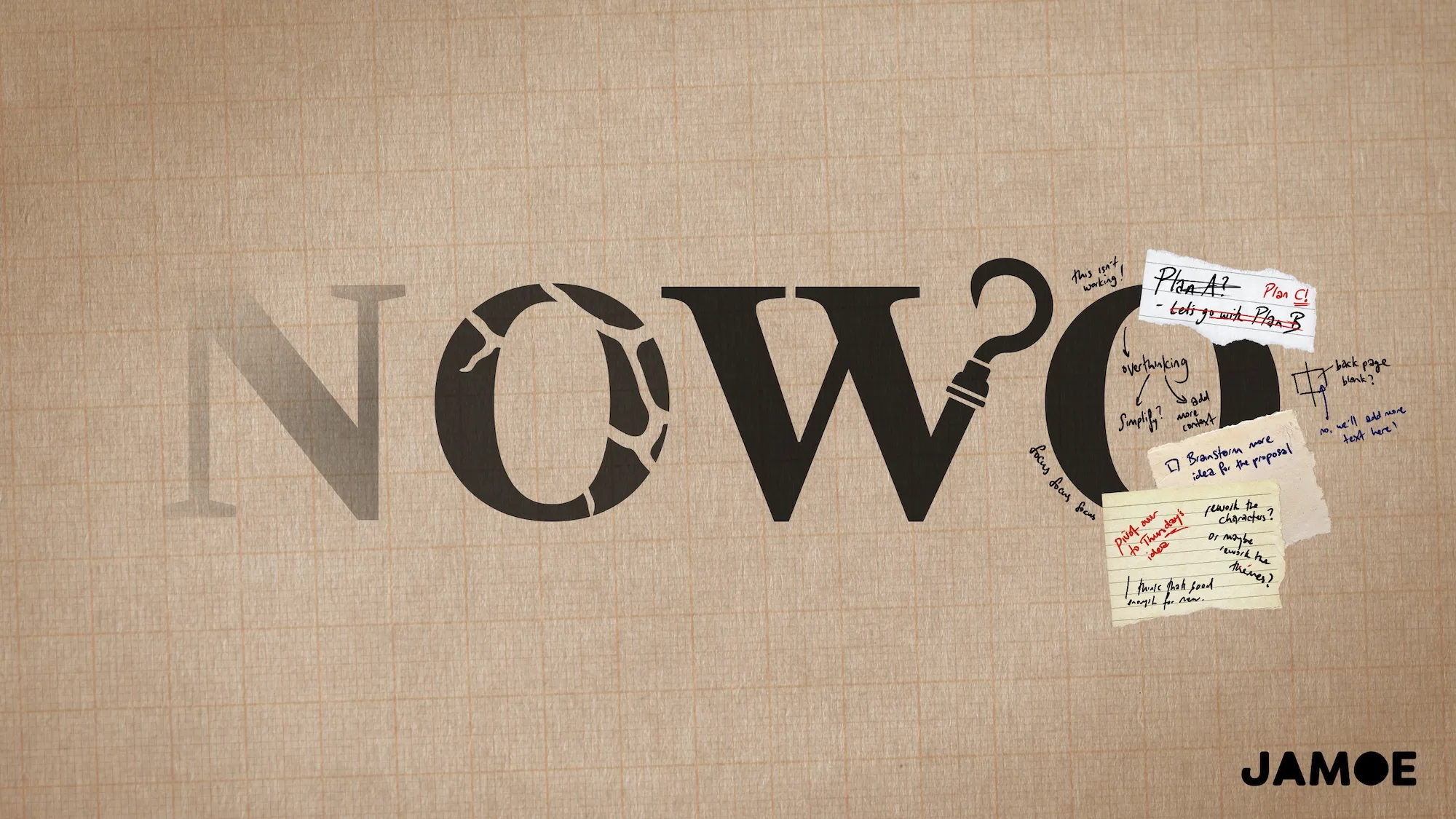
- Identifying which failure is happening and how to repair all boils down to NOWO.
Introduction
I wish I earned a bonus whenever one of my students said, ‘I have a terrible memory’. I could use the cash to end world hunger, clear the deficit, and have funds to spare for a holiday. The story is as common as it is misplaced and unhelpful.
Our memories are not ‘good’ or ‘bad’ in any meaningful general sense. Instead, they are specifically fallible. They fail in particular ways, under particular conditions, for particular reasons. And these reasons are largely diagnosable.
The big name in the field of memory is psychologist Daniel Schacter who spent most of his career at Harvard cataloguing the ways memory goes wrong.
Drawing on his 1999 framework, which he updated in 2021, I wanted to pair down the ‘sins of memory’ Schacter highlights to focus on the four most common ‘sins’ and share some practical steps you can take to understand, anticipate, and address your forgetfulness.
For each one, I’ll explain what is happening, how to recognise it, and what lever you can pull to fix it. The goal is not to give you a new technique to add to an already cluttered toolkit. It is to help you replace the vague complaint of ‘bad memory’ with a shrewder question: which kind of forgetting is this and how do I fix it?
The memory pipeline
Before exploring the failures, it helps to understand the system.
Psychologists often describe memory as a three-stage pipeline: encoding →→
- Encoding is how new information enters.
- Storage is how new information is held.
- Retrieval is how information gets back out.
When people say ‘I forgot’, they assume its a storage-related failure – like ink left in the sunlight, the memory has decayed and faded. The research, however, suggests that poor storage is the least likely culprit for forgetting.
A 2021 review of the forgetting literature found that the most common cause is retrieval rather than a permanent loss or erasure of memory: the memory is still there, we just don’t have an effective way of routing our way back to it.
Distilling the findings down, there are four main reasons for forgetting. Let’s go through them and then I’ll wrap them into a helpful mnemonic you can keep in your back pocket.
The Four Forgetting Failures
It never went in (encoding failure)
Attention plays a critical role in memory encoding, and most of us have our attention splintered by distractions – phones, children, dangers, scanning for dangerous children.
This explains so much of why we forget, and maps well onto the challenge of remembering names. When meeting new people, our attention is torn. We’re thinking about making a good first impression, whether our fly is down, or what canapés they’re serving.
Unless we’re giving something our undivided attention, saying ‘I forgot your name’ is inaccurate. If we’re being honest, we would say, ‘I wasn’t paying attention to your name because I was worrying about whether my breath smells’.
A lack of attention and its connection to impaired memory are even visible. The fMRI studies in the field found that the brain regions associated with encoding are significantly less active when attention is divided during learning. That’s why, when learning, multi-tasking is an especially terrible habit.
The self-check: do you recognise the material later? If it doesn’t feel familiar, you probably never encoded it.
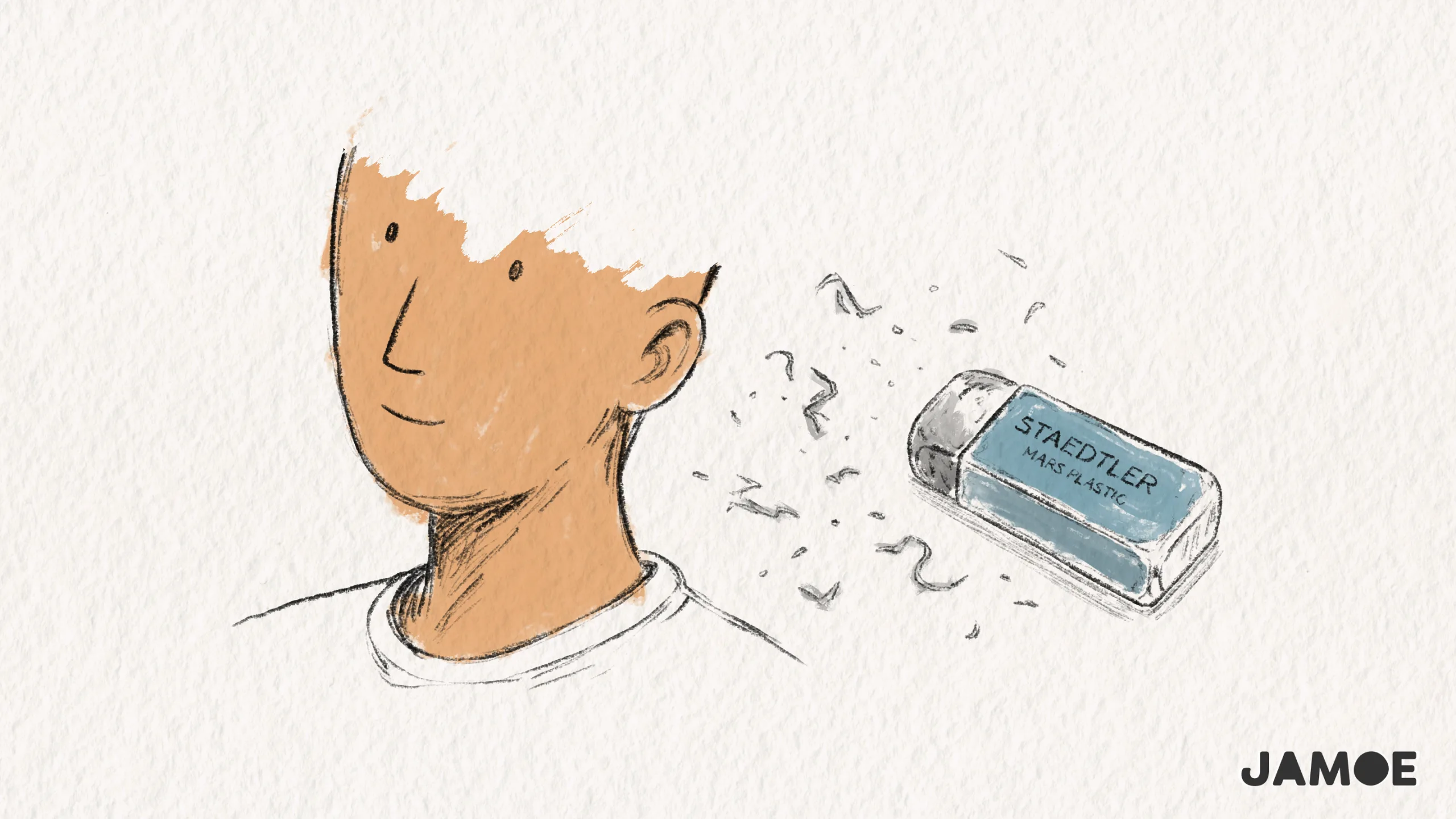
The repair: practice engaging with new material more deeply at the point of first contact. The most effective lever here is elaborative processing, a form of active learning. Asking yourself questions like ‘why does this matter?’ or ‘how does this connect to what I already know?’ The Feynman Technique and taking Oxford Notes is especially useful here, as they demand depth, which necessitates focus.
You only met it once (single touch)
The single touch failure is when new information is encoded, but only in a brief and shallow way without ever being revisited.
That’s the anatomy of cramming. You burst through lots of material, believe you understand it, and can explain it that evening. But try to recall it three days later and you’ll draw a blank.
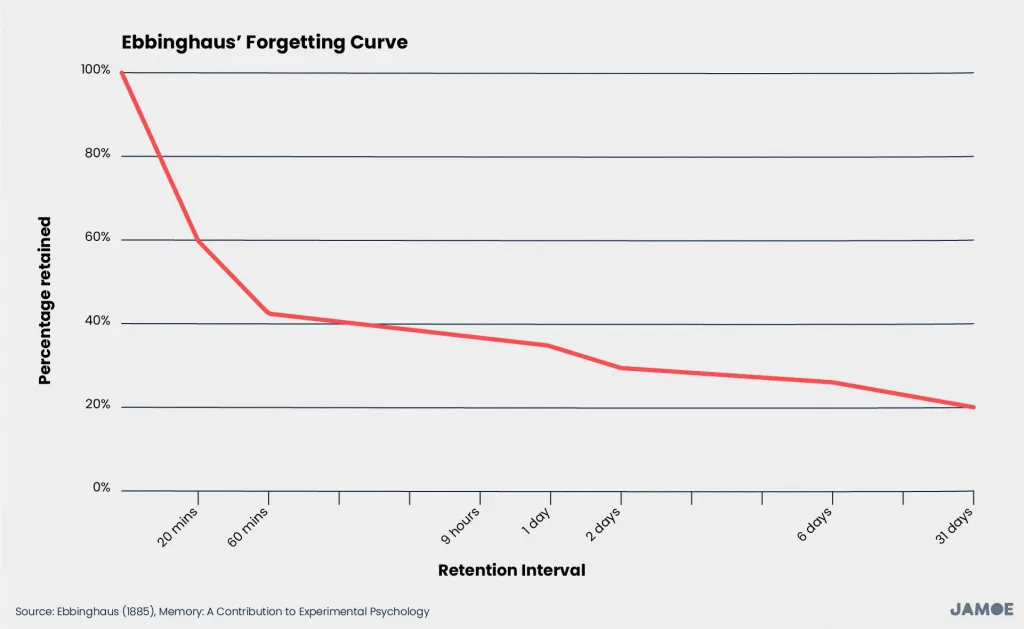
In this case, it’s more accurate to say ‘my memory trace was poor and never reinforced’ rather than ‘my memory is terrible’. Hermann Ebbinghaus, the go-to man on memory that I’ve written about before, found this when studying the quality of his own memory in the 1880s. He observed that, without review, more than half of newly learned information is lost within an hour, and two-thirds within 24 hours.
Ebbinghaus called this decline the ‘forgetting curve’ and also laid the groundwork for disrupting this curve. Each time you return and recall a piece of information, the curve resets to a higher baseline. This was corroborated in a 2011 memory study that found spaced repetition increased retention by around 200% compared to cramming. The total study time between both groups was held constant.
The self-check: does the material feel familiar but inaccessible? Can you recognise it when prompted but not retrieve it unprompted? That’s a single-touch problem. It’s the difference between excelling at a multiple-choice tests, but stumbling on a blank page exam. If you need options in front of you to spot the right answer, the trace is there, but it’s weak, unusable, and needs repeated practice to come out on demand.
The repair: space your revisits. You don’t need a complex system to do this. I advocate keeping things simple, feeling the impact, and then seeing what ‘system’ you might build once you’ve secure your faith in the method.
In Oxford Notes, I recommend returning to your notes on day 1, day 3, and day 7. Even with a week of resting and reviewing, you’ll find the memory trace is far more robust.
For more guidance on this and developing a practical approach, see A Practical Guide to Memorising Anything with Spaced Repetition.
The hook is weak or missing (retrieval failure)
The research suggests this is the dominant form of forgetting: the information is in there, but you can’t get it out. This is a retrieval failure.
This failure is the strangest to imagine. You know you know something, like the name of your first born child, but in this moment, you can’t, for love nor money, recall what she’s called. This is the tip-of-the-tongue phenomenon, which was described by researchers in 2026 as ‘a transient state in which speakers momentarily fail to retrieve a known word despite preserved semantic knowledge and a strong sense of imminent recall’.
Our brains take in our context when encoding new information: our mood, our environment, the music we’re listening to, the soup we’re drinking. These contextual pieces form the pathway and signposts for retrieving that information later. When your context changes, like moving from a classroom to a grey exam hall, many of the cues present during encoding are missing and the knowledge becomes inaccessible.
The self‑check: does the information feel familiar but unavailable on demand? Does it come back later, unprompted, when you have stopped trying? That’s a retrieval problem.
The repair: build better hooks at the point of learning. Mnemonics – acronyms, acrostics, the first‑letter technique, vivid images, short stories – work by giving your future self a more reliable cue to tug on. The stranger and more concrete the hook, the more likely you’ll be able to recall it and use it to retrieve the knowledge you’re looking for. Doing this allows you to develop more robust knowledge that’s independent of your emotional or environmental context.
For specific techniques, see The Oldest Memory Trick: Acronyms and Acrostics and The Actor’s Memory Trick: The First‑letter Technique.
You’re carrying too much (cognitive overload)
The fourth form of forgetting is when the system itself becomes overwhelmed. When your mental load is high – too many obligations, plates to spin, stresses to manage – your working memory becomes cluttered, like a desk covered in paperwork. When working memory is at its capacity, new information can’t be encoded properly and existing information is harder to find.
That’s why forgetfulness is so high when rushing or during periods of grief, threat, and burnout. Your entire memory system is clogged and fried.
Cognitive load theory, developed by educational psychologist John Sweller, formalises this: when the combination of intrinsic difficulty and extraneous mental noise overwhelms working memory, learning and recall both deteriorate. Forgetting in this state is not a failure of the memory system. It is the predictable result of asking any limited system to do too much at once.
The self‑check: does your forgetting feel global? Are you dropping several things at once? Is the period of forgetfulness tracking a period of high stress or competing demands?
The repair: the problem here is not the quality of your memory, but how much you have on your plate. Reducing or managing your stress, healing open wounds, or giving yourself grace should be your focus. There are many avenues you can explore to clear your cognitive desk, like closing the number of open loops you’re carrying by writing them down and giving them a home.
Once the noise drops, recall improves without any specific memory work. For a practical guide to this, see Closing Loops, Re‑energising Your Life, Evening Pages: Procrastinate Less and Sleep More, and Good Stress, Bad Stress.
NOWO: Fixing your forgetting in practice
When you find yourself forgetting, you can now run a quick diagnostic to see which kind of forgetting you’re experiencing:
- Didn’t recognise the information? You never encoded it. Give it your full attention next time, and play with it to elaborately process the information.
- Familiar but hazy after a few days? You met it once. Space out your recalls.
- On the tip of your tongue? The hook is bad. Build a better cue.
- Dropping several things at once? Your cognitive desk is full. Declutter before adding more.
You’ll likely start seeing different contexts produce different failure modes. Names at parties are usually encoding failures – you were distracted when introduced1. Foreign vocabulary is often a single-touch problem – you studied the word once and moved on. Recalling work processes at home are often retrieval failures – the information is there, but the right trigger is not. Periods of high stress usually cause overload failures across the board.
If you’d like a single hook to hang spotting these failures on, I’ve created the mnemonic NOWO:
- Never encoded
- Only once
- Weak hook
- Overload
The next time you blank on something, run through NOWO and ask which one is true. Once you know which problem you are dealing with, the fix is usually straightforward: pay more attention, see it again, add a hook, or lighten the load.
The piece you are reading sits inside my series on memory. If you would like to go further, you might read them in this order: start with A Practical Guide to Memorising Anything with Spaced Repetition for the core technique behind single‑touch failure. Then A Practical Guide to Learning Anything Faster with The Feynman Technique for encoding depth. Then The Oldest Memory Trick: Acronyms and Acrostics for retrieval cues. Good Stress, Bad Stress, Evening Pages, and Closing Loops, Re‑energising Your Life if overload is the one that sounds most familiar. For a complete note-taking method for remembering more and understanding faster, see Oxford Notes.
- Most recently, I remembered the name of my new Irish friend by thinking of what rhymes with it. I settled on ‘lemonade’. Her name was Sìnead. ↩︎