At a glance
- Based on the reader question: I used to be in great shape and sharper at work. After a rough few years, I feel like I've lost it. Is all that past effort wasted?
- Your past effort is never wasted. When you train your body or mind, you lay down physical and neural structures that persist long after you stop – and allow you to recover far faster than you built things the first time
- The practical upshot: what feels like starting from scratch is actually returning to a compressed version of your past self, one that decompresses much faster than it took to build
Introduction
Your past effort is never wasted. Even after injury, illness, or years of neglect, your body and brain retain far more of what you built than feels possible and, when you return, you recover it far faster than the first time you built it.
This cuts against what we usually tell ourselves when a setback hits: I'm back to square one. All the effort and pain I invested has been wasted. It's a demoralising story with an outsized influence on our thinking – which is annoying, because it's also false.
So let's get into the consoling truth and change how you approach your next comeback.
In this piece, I'll share how muscle memory works at a cellular level, and why previously trained muscle regains size and strength significantly faster than novice muscle ever builds it. I'll then show you the parallel in the brain: how old knowledge and skills sit dormant rather than deleted, and how relearning works faster than first learning. Finally, I'll offer a small set of practical moves for using this knowledge to actually get back in the saddle – including one reframe that neatly dismantles the most demoralising part of starting again.
But first, a story about a man sitting on a sofa in Los Angeles, wondering whether it was too late.
The man who came back for his son
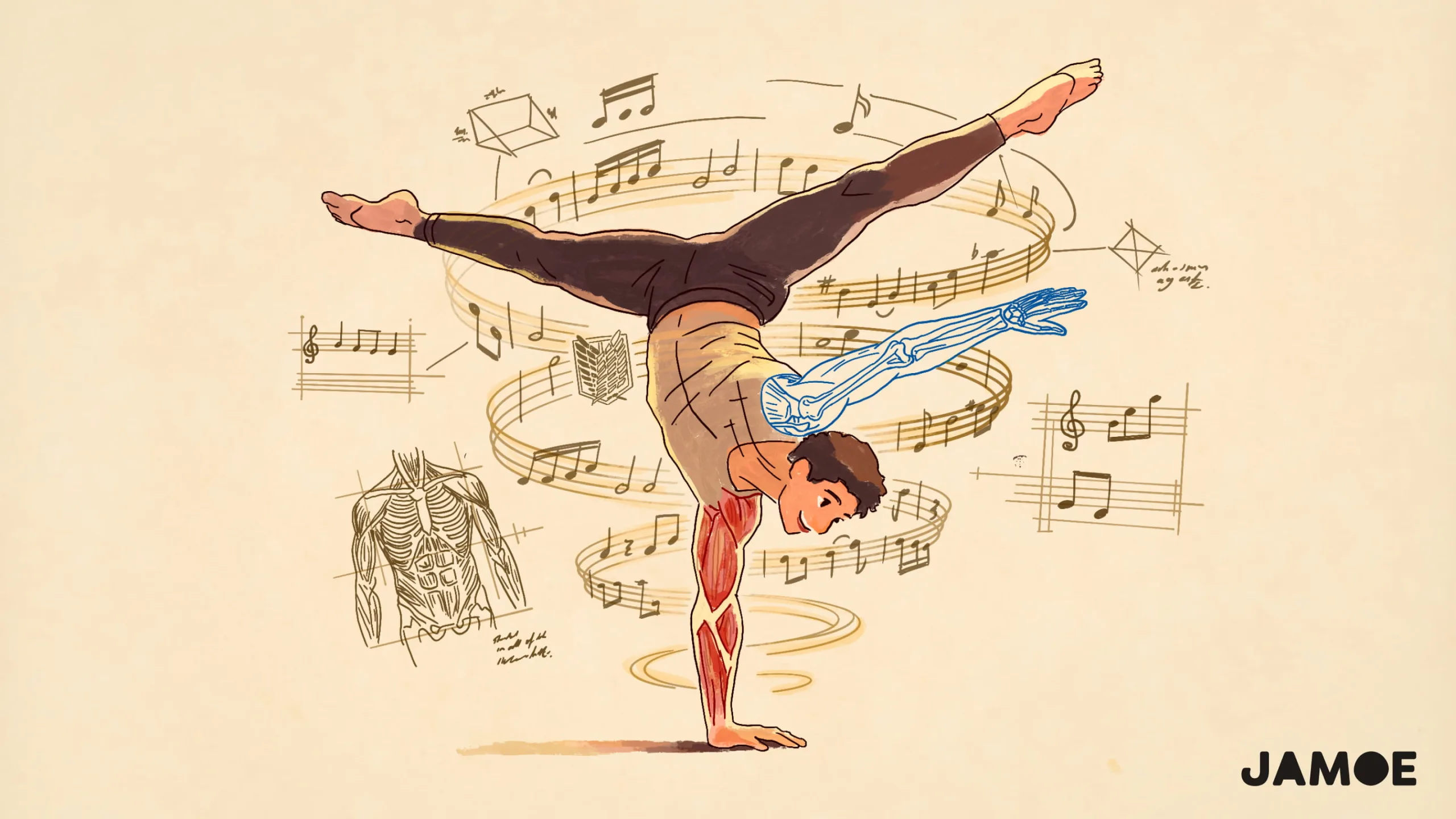
In the summer of 2021, Tom Daley won Olympic gold at the Tokyo Games for Great Britain – the 10m synchronised event, alongside Matty Lee – after more than a decade of near-misses that included two bronze medals, a very public bereavement, and the kind of pressure that breaks most people. He was 27. He had competed at four consecutive Olympic Games since Beijing 2008, when he was 14 years old. After Tokyo he announced his retirement and moved to Los Angeles with his husband and his two sons.
Two years passed and in the summer of 2023, Daley visited the US Olympic and Paralympic Museum in Colorado Springs with his family. At the end of the visit, they were shown into a room to watch a film about what it means to be an Olympic athlete. Daley later described what happened: 'I sat there with Robbie, the video started, and I just wept. I couldn't control myself; it was like I hadn't grieved diving.'
Six-year-old Robbie looked up and asked what was wrong. Daley said he missed diving. 'Well, Papa,' Robbie said, 'I want to see you dive at the Olympics.'
That, Daley later told Sky Sports, was it: 'It actually all came down to my son Robbie, who wanted to see me dive again.' He officially returned to training in December 2023. Within six months he had won gold at the World Championships. By the summer, he was at his fifth Olympic Games, where he won silver in the 10m synchronised event alongside Noah Williams.
On the flight home, having fulfilled his son's wish, he announced his retirement. This time for good.
Before the Games, Daley was bracingly honest about the asymmetry: 'There's a reality that I've only been training for the last year when everyone else has been training for three years.' He wasn't pretending he'd lost nothing. He was acknowledging the gap and diving anyway.
What he perhaps didn't fully account for was what his body had been keeping in reserve during those two years on the sofa. Because the question worth asking – the one with implications well beyond elite sport – is this: how was any of that possible? What was going on inside him that allowed a two-year retirement to be compressed into a six-month comeback?
The answer has a name. And it applies to you too.
How muscle memory works: the biology of stored effort
Previously trained muscle grows back faster than untrained muscle builds from nothing. This is the reality behind muscle memory, and it's well-supported by the training literature.1 But what's actually going on inside the muscle to make that possible?
When you lift weights and your muscles grow, they don't grow alone. The muscle fibres recruit extra myonuclei – tiny cellular nuclei pulled from nearby satellite cells, which fuse into the fibre and increase its capacity to build protein.2 Think of myonuclei as new factories being built during periods of rapid expansion. Each one increases the fibre's ability to ramp up production when demand calls for stronger muscles.
The old assumption was that when you stopped training and lost size, those extra nuclei simply died off. The research of the last fifteen years has progressively challenged that view.
In a landmark 2010 study, Kristian Gundersen and colleagues at the University of Oslo tracked live myonuclei in mouse muscle fibres over time.3 They found that new myonuclei – the factories – were added before any significant growth in fibre size – and crucially, when those fibres subsequently shrank by more than 50%, the extra nuclei remained. Gundersen later proposed a fuller cellular model: previously trained fibres that have acquired a higher myonuclear count grow back faster when training resumes, because the nuclei represent a functionally important memory of previous strength – one that may be stable for at least 15 years, and possibly permanent.4
A 2022 systematic review and meta-analysis of 147 studies examined the evidence for myonuclear permanence across both human and animal studies, finding stronger support in rodents than in humans – though the functional outcome, faster recovery after detraining, remains consistent across the broader literature.5 One study even found that previously trained subjects regained peak strength – not just size – in under eight weeks.6
Boiling things down
You train, the myonuclei – the muscle-building factories – get made, your muscles grow, you pause, your muscles shrink but the factories remain, ready to ramp up production whenever you give them the signal to get strong again.
Knowing what's happening inside your muscles is consoling when you need to take a break. You're losing visible size, not the underlying infrastructure. So while the visible size and strength will wax and wane with your habits, all the infrastructure you've built endures. Which is how a man who spent two years on a sofa in Los Angeles could climb back onto a 10-metre platform, win gold at the World Championships, and then compete at his fifth Olympic Games – all within a year of returning, against divers who had spent more than twice as long preparing.7
Your brain keeps the roads, too
The same pattern plays out in the mind. Old knowledge and skills aren't a 'use it or lose it' deal. They go dormant and, when you wake them up, reform much faster and more robustly than before.
When you learn something difficult well – a language, a syllabus, a craft, a professional skill – you're not only storing isolated facts. You're building structures: solid explanations, organised categories, retrieval routes through complex material.8 The road system, once laid, doesn't vanish because the traffic has thinned. It waits.
Ebbinghaus's savings method
The oldest evidence for this comes from Hermann Ebbinghaus, who in 1885 introduced what he called the savings method: a way of measuring not what you remember, but how much less effort it takes to relearn something you've previously learned.9 His insight was that forgetting is never total. Even when you can no longer consciously recall material, a trace remains – and that trace cuts the cost of relearning significantly. If it took you ten minutes to learn something originally and only four minutes to restore it, your savings score is 60%.
A 2022 large-scale study of over 39,000 people practising cognitive skills on a learning platform confirmed that the savings effect is real and robust even after very long gaps.10 Performance recovered rapidly within just a few sessions, even after delays of over two years. The researchers concluded that relearning couldn't be explained without skills leaving long-term traces in the brain. So while the roads might go quiet, they don't disappear. When you return, you're not excavating new terrain – you're filling in a few potholes.
The skills that almost never leave
There is a folk version of this that most people have heard: you never forget how to ride a bike. It turns out to be literally true.
A 2013 study tracking a complex motor skill found that nearly all performance measures persisted remarkably after gaps of both six months and eight years.11 The savings weren't just significant. For well-practised skills, they were nearly total.
The neuroscience behind this is straightforward: your brain stores two fundamentally different kinds of memory in two different places. Factual and episodic memory – names, dates, what you revised for your A-levels – lives in the hippocampus. Motor skills – riding, swimming, typing, playing an instrument – are stored separately, in the cerebellum, as procedural memory. The distinction matters because the cerebellum encodes these skills so deeply, through thousands of repetitions, that they become effectively automatic. And automatic, it turns out, means durable in a way that conscious recall simply isn't.
That said, 'never forget' holds most reliably for skills that were overlearned, that is, practised well beyond initial mastery.12 Skills that were only half-built are more vulnerable to decay. Which is, in its own way, another argument for putting the work in the first time.
Successive relearning
And the number of potholes gets smaller every time. Follow-up work on 'successive relearning' – deliberately relearning the same material over spaced sessions – shows that this savings effect can push long-term recall from around 20% to roughly 80% with the same total study time, by revisiting and reinforcing old roads rather than trying to lay new ones. That's the power of spaced repetition.
Practical moves: how to come back
Work below your remembered peak, above your current comfort
The first few sessions back will feel humiliating. That's the price of reawakening your past performance. If you used to run 10k, don't start with 10k. Build up. Start with 3k, adjust, and incrementally work your way back up.
I didn't do this. A part of me thought lifting lighter weights was embarrassing. My body hit back with injury and exhaustion. Going slow turned out to be the faster route. Now I'm pretty religious about letting the cellular machinery reactivate after a break rather than setting it on fire with too much enthusiasm or ego.
Relearn on purpose
Pull out an old set of notes and schedule a short series of active recall sessions – not to catch up to where you were, but to walk old routes again.13 Each pass strengthens the underlying scaffold. The next time life detonates, more will survive intact.
Reframe 'starting again' as 'returning'
'Starting again' frames your past self as someone who wasted their time on your behalf. 'Returning' frames them as a friend – a previous version of you who banked effort and left you a head start. Or, if you prefer, someone who built you an escalator so you don't have to take the stairs every time.
The essential thing
In a 2024 interview, Daley was asked whether he regretted coming back, given the gap in training time. He said he didn't – not because the medal made it worth it, but because of what happened when he stood on the board. 'I'm so excited to see my little kids' faces when I am stood on that diving board,' he said. 'That's why I've come back.'
His answer assumed something: that there would be something left when he got back up there. That two years away hadn't taken the essential thing. He was right. The technique, the timing, the accumulated knowledge of ten thousand dives – none of it was gone. His body had held onto all of it while he got on with being a father and a husband and nothing else.
If you've had a bad few years, you are owed the same assumption. Setbacks strip the visible performance and the confidence. They do not send you back to zero. What they leave behind is a compressed version of your past self – one that can be decompressed much faster than it took to build the first time. The myonuclei are still there. The old roads are still there.
You are not starting from scratch. You are returning. And returning, as it turns out, is easier than it feels.
- Staron, R.S. et al. – 'The effect of resistance training, detraining and retraining on skeletal muscle', Journal of Strength and Conditioning Research, 2020. ↩︎
- Gundersen, K. – 'Muscle memory and a new cellular model for muscle atrophy and hypertrophy', Journal of Experimental Biology, 2016. ↩︎
- Bruusgaard, J.C. et al. – 'Myonuclei acquired by overload exercise precede hypertrophy and are not lost on detraining', PNAS, 2010. ↩︎
- Gundersen, K. – 'Muscle memory and a new cellular model for muscle atrophy and hypertrophy', Journal of Experimental Biology, 2016. ↩︎
- Cramer, J.T. et al. – 'Myonuclear permanence in skeletal muscle memory: a systematic review and meta-analysis of human and animal studies', Journal of Cachexia, Sarcopenia and Muscle, 2022. ↩︎
- Blocquiaux, S. et al. – 'The effect of resistance training, detraining and retraining on muscle strength and power, myofibre size, satellite cells and myonuclei in older men', Experimental Gerontology, 2020. ↩︎
- The cellular mechanism behind muscle memory is better established in animal studies than in humans, and some human trials have not replicated the myonuclear retention effect directly. What the broader literature does consistently support is the functional outcome: previously trained people regain lost muscle and strength significantly faster than true beginners build it. The exact cellular route is still being mapped. The destination isn't in serious dispute. ↩︎
- Also check out the Feynman Technique and Spaced Repetition for practical guides to building and revisiting these structures. ↩︎
- Murre, J.M.J. & Dros, J. – 'Replication and Analysis of Ebbinghaus' Forgetting Curve', PLOS One, 2015; Murre, J.M.J. – 'Why Ebbinghaus' savings method from 1885 is a very pure measure of memory performance', Psychonomic Bulletin & Review, 2022. ↩︎
- Sense, F. et al. – 'Comparing models of learning and relearning in large-scale cognitive training data', Science of Learning, 2022. ↩︎
- Penhune, V.B. & Steele, C.J. – 'Learning to never forget – time scales and specificity of long-term memory of a motor skill', Frontiers in Computational Neuroscience, 2013. ↩︎
- Can You “Forget” How to Ride a Bicycle? The Laws of Behavior Say: Sort Of, Behaviour Analysis Blog, 2025. ↩︎
- Rawson, K.A. & Dunlosky, J. – 'The benefits of successive relearning on multiple learning outcomes', Educational Psychology Review, 2022. ↩︎