
At a glance
Reader question: I keep replaying a memory that either gets worse each time or still hurts years later. Is my memory broken, and can I do anything about it?
- Memory is rebuilt, not replayed: each recall is shaped by who you are now, so memories can become kinder or crueller.
- We ask too much of memory: it evolved to help us act and make sense of ourselves, not to archive reality.
- A memory’s weight isn’t fixed: how, when and with whom you revisit it may change how it feels, though the evidence is still early.
Introduction
If you’ve ever replayed a joyful conversation until your recollection of it turns sour, you’ve met the problem this piece is about.
We expect our memory to hold an accurate record of what happened, but it doesn’t, and it was never meant to. Once we appreciate how it evolved, we can make our relationship with the past less fixed and less heavy, and start rewriting our personal narrative for the better.
How memories are stored
Human memory doesn’t work as science fiction would have us believe. We can’t pluck a memory from our minds like a video file from a directory and play back an objective record of a past moment.
In part, that’s because every time we retrieve a memory, it changes. It is reshaped, rebuilt and recoloured by who we are at the moment of recall. Our environment, emotional temperature, morals, values and even the timing of our last meal can affect our recollection – the memory of a prison dinner, for example, starts to look far more appetising when you’re starving.
Even a single word can shift what we recall. In a classic 1974 study, Elizabeth Loftus and John Palmer showed people a film of a car crash, then asked how fast the cars were going when they ‘hit’ or ‘smashed into’ each other. Those asked the ‘smashed’ version gave higher speed estimates and, a week later, were more likely to remember seeing broken glass, though there was none in the film.1
Why does our memory do this? Isn’t it meant to give us an accurate representation of the world? Well, no. The expectation that it should serve as a reliable archive is a modern one.
Just as our legs never evolved to carry us into space, our memories never evolved to store an objective record of reality. Fortunately, our other mental faculties have helped us build tools to overcome these limits: spacecraft and record-keeping systems.
When we embrace these record-keeping tools and free our minds from the burden of recalling every word someone said six years ago, we can start asking why our memories evolved this way and how they can serve us.
Adjusting our expectations
Modern society asks memory to serve as witness, diary and filing cabinet. We then feel like failures when our faculties fall short of the tasks we’ve set them.
Yet human memory is better understood as a system that helps us act in the present, make decisions, exercise judgement and tell a coherent story of who we are and where we’ve come from.
The psychological immune system
A useful way to think about memory comes from the psychologists Daniel Gilbert and Timothy Wilson. They describe what they call the psychological immune system: the rationalising and reframing that helps us make sense of setbacks and recover faster than we expect.2 To me, the way memory recolours the past in light of the present suggests it is one of this system’s tools.
Our biological immune system protects us against pathogens, but it can also overreact to things that are harmless, as with allergies. Our psychological immune system is no different. Take these two examples.
A kinder drift
In studies by Terence Mitchell and colleagues, people reported on their experiences during and after a trip to Europe, a Thanksgiving holiday and a three-week cycling tour of California.3
Afterwards, their recollections were more positive than their reports at the time.
The gap between their grumbles during these experiences – about rain, exhaustion or missed connecting flights, for instance – and their positive reviews weeks later reflects the way our memories sand down the worst edges to ease our discomfort.
A distorted drift
Imagine replaying a conversation with a friend on the way home, again that night and again in the shower. Each time, their tone gets a little colder and your reply a little sharper. By the weekend, you remember it as a fight.
Each replay retrieves and rebuilds the memory, using the previous draft as its source.
Directing the drift
If our memory rebuilds the past through who we are now, rather than who we were then, we have more say in our story than we thought. That’s especially encouraging when we want to change how we relate to experiences that hold us back or cause us pain.
Here’s an idea to play with: what we carry is not the past itself, but the latest draft we’ve reconstructed. The events are fixed, but their weight can be moulded by the attention we give them.
Early research has shown a version of this in the lab. In 2010, Daniela Schiller and colleagues found that old fear memories in humans could be updated with non-fearful information if the memory was reactivated first, and their fear responses stayed down afterwards.4 The idea is that a reactivated memory briefly becomes changeable, allowing new information provided in that window to be folded in.5
Hold this loosely. That was laboratory fear conditioning, not grief or betrayal, and replication results have been mixed.6
Putting the idea to work
Learning this gave me a few ideas for changing how you relate to memories that weigh you down, or to stories you keep replaying. After all, we are the stories we tell ourselves. Here are five to try.
- Visit, don’t dwell: Return to a painful memory deliberately, when you are calm and have somewhere to put it down afterwards, rather than when it ambushes you at 3.47am. Rehearsing it in the same distressed state may simply strengthen the same version.
- Add what you know now: When you revisit, bring the missing context with you: that you did your best with what you knew, that the other person was struggling too, that you survived it.
- Tell it differently: Describe it as you would to a friend, or from a year ahead.
- Write the facts down once: Record what happened, plainly, while it is fresh. The note gives your memory the source document it otherwise lacks.
- Don’t open the worst ones alone: If a memory is overwhelming, reopening it without support can hurt more than it helps. A good therapist provides the safe context this research relies on.
The active recall paradox
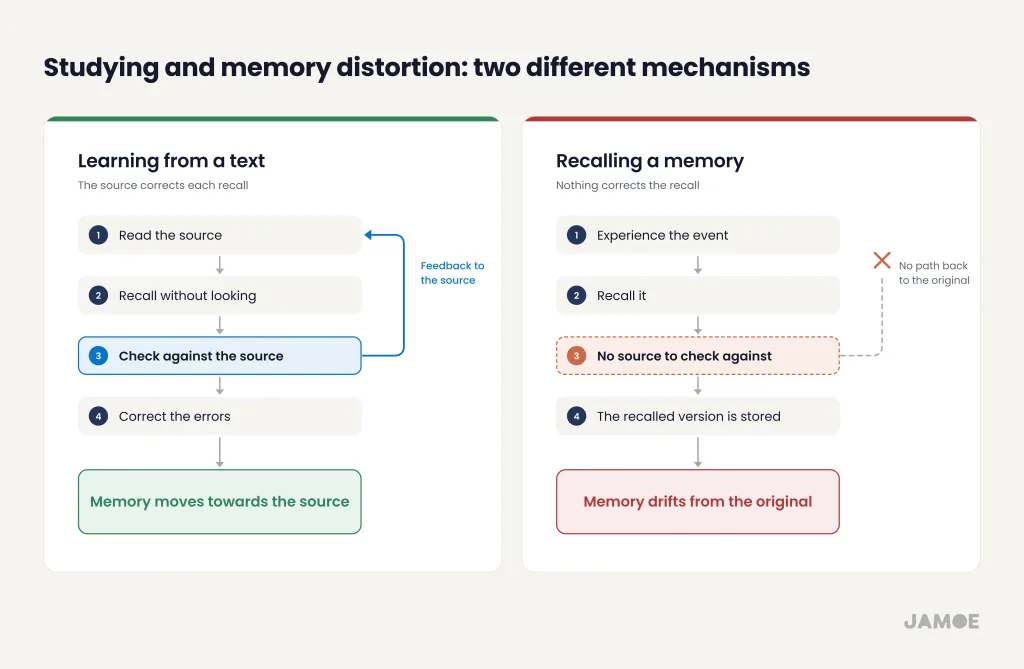
If every recall rewrites a memory, studying should leave us with a more distorted record each time. Does that make learning futile?
In practice, though, that isn’t what happens. Active recall, one of the best-supported study techniques, reliably improves how much people remember.7
The difference is that when we study, the textbook is the source of truth. We recall, check ourselves against the source text and correct. That allows us to repair what’s drifted before it sets.
In contrast, nothing checks the story of our own lives, so the version we rehearse becomes the original.
The latest draft
I can’t promise that revisiting the worst day of your life will make it lighter. Some memories will stay heavy, and some deserve kind, safe and perhaps professional company before they are opened.
What I can say is that the past you carry is not the past itself. It’s your mind’s latest draft, and drafts can be revised, slowly and with some care.
Your memory isn’t perfect, but be patient with it. It’s been trying to look after you all along.
- Loftus, E.F. & Palmer, J.C. (1974), ‘Reconstruction of automobile destruction: An example of the interaction between language and memory’, Journal of Verbal Learning and Verbal Behavior 13(5), 585–589. https://doi.org/10.1016/S0022-5371(74)80011-3 ↩︎
- Gilbert, D.T., Pinel, E.C., Wilson, T.D., Blumberg, S.J. & Wheatley, T.P. (1998), ‘Immune neglect: A source of durability bias in affective forecasting’, Journal of Personality and Social Psychology 75(3), 617–638. https://psycnet.apa.org/record/1998-12057-003 ↩︎
- Mitchell, T.R., Thompson, L., Peterson, E. & Cronk, R. (1997), ‘Temporal adjustments in the evaluation of events: The “rosy view”’, Journal of Experimental Social Psychology 33(4), 421–448. https://pubmed.ncbi.nlm.nih.gov/9247371/ ↩︎
- Schiller, D., Monfils, M.-H., Raio, C.M., Johnson, D.C., LeDoux, J.E. & Phelps, E.A. (2010), ‘Preventing the return of fear in humans using reconsolidation update mechanisms’, Nature 463, 49–53. https://www.nature.com/articles/nature08637 ↩︎
- Nader, K., Schafe, G.E. & LeDoux, J.E. (2000), ‘Fear memories require protein synthesis in the amygdala for reconsolidation after retrieval’, Nature 406, 722–726. https://www.nature.com/articles/35021052 ↩︎
- Replication and critique:
• Chalkia, A., Van Oudenhove, L. & Beckers, T. (2020), a registered replication of Schiller et al. (2010), Cortex 129, 496–509. https://pubmed.ncbi.nlm.nih.gov/32580869/
• Schiller et al. (2018), Addendum, Nature 562, E21, on exclusion criteria. https://www.nature.com/articles/s41586-018-0405-7
• Lázaro-Muñoz, G. & Diaz-Mataix, L. (2016), AJOB Neuroscience 7(4), 244–247, which questions the clinical evidence for propranolol-based reconsolidation treatments, a drug approach that differs from Schiller’s behavioural one. https://pmc.ncbi.nlm.nih.gov/articles/PMC5365236/ ↩︎ - Roediger, H.L. & Karpicke, J.D. (2006), ‘Test-enhanced learning’, Psychological Science 17(3), 249–255. https://pubmed.ncbi.nlm.nih.gov/16507066/ ↩︎
This piece was inspired by the Kurzgesagt video: How Are Memories Stored Inside Your Brain?