
A Personal Finance Flowchart

by Jamie Miles | Jul 5, 2020 | True Stories & Reflections

Inertia's a funny thing. Back when I was 14, I decided to give up something for three months for New Year's. The choice was obvious: fizzy drinks. They'd become a staple, and at 14 it felt like a true test of will power.

3 months passed, and I found myself celebrating the challenge's completion with an ice cold can of Coca Cola to quench my thirst on what was a surprisingly warm spring afternoon.

With a single celebratory sip, I'd concluded that Coca Cola was disgusting.

It was too sweet, the fizz stung my mouth, and made my eyes water. How could I have liked this drink so much? How could I have liked any fizzy drink?

Inertia was the answer. Fizzy drinks were a habit, much the same as brushing my teeth, and that small disruption made me realise that fizzy drinks weren't for me. However, forgetting to brush my teeth makes me realise how much I should definitely brush my teeth(!).

The lockdown has been a big disruptor for us all, which means actions driven by inertia have been sapped of their power: habitual morning coffees, Pret lunches, and Saturday takeaways are all being reconsidered.

A more extreme version was being made redundant from Airbnb. While I loved my job, in the absence of inertia's power, I've come to realise how much I love the thrill of being an entrepreneur and running my own business, which has been a silver-lining that I'm grateful for.

Is inertia making you do something you don't want to do?

🌱 A Personal Finance flowchart
With this period of pause, it’s prime time to take stock of your finances and see what tweaks you can make.

As a sense-check, below you’ll find a flowchart that prioritises the fundamental steps you should take to achieve financial security.

It’s not a get rich quick flowchart, and anyone who says they have one is toxic, and should be ignored.

The flowchart will be the first in a series of posts on how one could set up their personal finances in their 20s, and will include what I've learned from economics, working in finance, and what I wish I’d been told sooner.
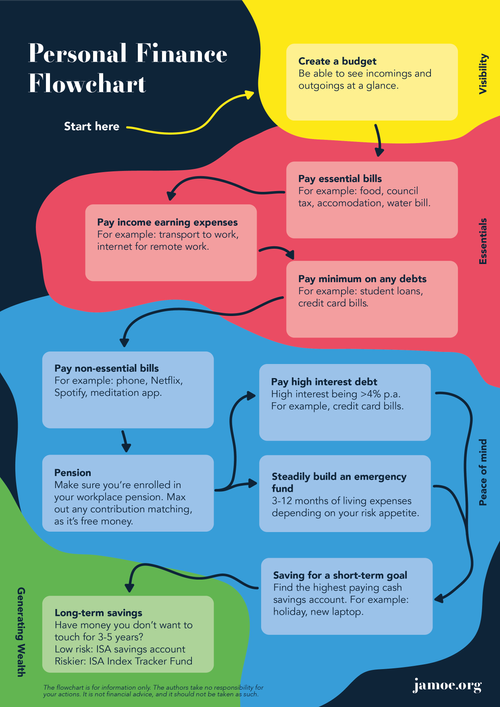
Personal-Finance-Flow-01.png

Stay curious,

Jamie

The End

Enjoyed this? You'll love Sundays.

NEWSLETTER

📮Jamie's Journal

Written for kind, curious, and ambitious readers looking for better ways to think, feel, and live fully.

Every other Sunday, you'll receive the insights I wish I'd known sooner: true stories, reflections, recommendations, and practical guides for learning, thinking, and navigating the world with more intention.

No noise. Just a little hindsight to guide your foresight.

You May Also Like...

Why You Keep Forgetting (and How To Fix It)

Why You Keep Forgetting (and How To Fix It)

Our memories are not ‘good’ or ‘bad’ in any meaningful general sense. Instead, they are specifically fallible. They fail in particular ways, under particular conditions, for particular reasons. And these reasons are largely diagnosable.

Creative Company

Creative Company

I found Vincent the way you find most good things: in a bookshop. We were both attending a signing event by one of our favourite authors and happened to be neighbours in the queue. As seems to be custom for my best friends, Vincent promptly left the country.

The Art of Magnetic Conversation: Build Up, Not Out

The Art of Magnetic Conversation: Build Up, Not Out

Learning to bring a conversation to life turned out to be simpler than I expected, and the insight came from an unlikely place: improv.

Specifically, from realising I’d been misreading its foundational principle, ‘Yes and…’. Once I corrected my understanding, I started noticing it everywhere, especially in the people I find the most magnetic to talk to.

The Oil Layer

The Oil Layer

This week, I figured out that the entire wellness supplement industry was, for most practical purposes, a very attractive wall of nothing. I did this while trying to fix my eyes. Nobody was particularly interested.

The Comforts of Muscle Memory and The Man Who Came Back For His Son

The Comforts of Muscle Memory and The Man Who Came Back For His Son

Your past effort is never wasted. Even after injury, illness, or years of neglect, your body and brain retain far more of what you built than feels possible and, when you return, you recover it far faster than the first time you built it. So let’s get into the consoling truth and change how you approach your next comeback.