At a glance
Based on the reader question: Why do I keep circling back to the same wrong idea, and the same old grudge, and how do I actually let either one go?
- A mind that cannot forget, like Borges' fictional Funes or a real hyperthymesiac, loses the ability to abstract, generalise, and build workable ideas from experience, making total recall is a curse, not a gift.
- Getting stuck on a bad solution at work and getting stuck on an old grudge at night are the same underlying failure: an inability to disengage attention from something familiar and redirect it elsewhere.
- The fix transfers across both problems: force a second candidate before accepting the first, consult yourself as though you were someone else, and give unhelpful memories a proper, deliberate goodbye.
Introduction
Nobody talks about the curse of the man who couldn't forget.
Funes, a man of fiction created by Jorge Luis Borges, fell from his horse and woke up with the mind of an elephant. He could recall, in vivid detail, every moment, seeing every leaf on every tree, from every day of his life. We often covet and celebrate a mind with such power. Funes hated it.
The power of memory ruined him, and it ruins people in real life, too. Hyperthymesia is the name given to Funes' condition, and neurologists have made efforts to find and study those living with memories that don't quit.
Borges imagined the unforgetting mind would be unable to think, for thinking is the ability to generalise, let nuances blur, and build clean ideas out of thousands of examples. But Funes was overloaded and couldn't separate the forest from the trees, preventing him from building any mental models from his experience.
The neurologists found the same was true for the hyperthymesiacs. Total recall didn't make them sharper; it compromised the key feature of intelligence: being able to abstract from a mess of specifics, find patterned insights, and turn them into workable ideas.
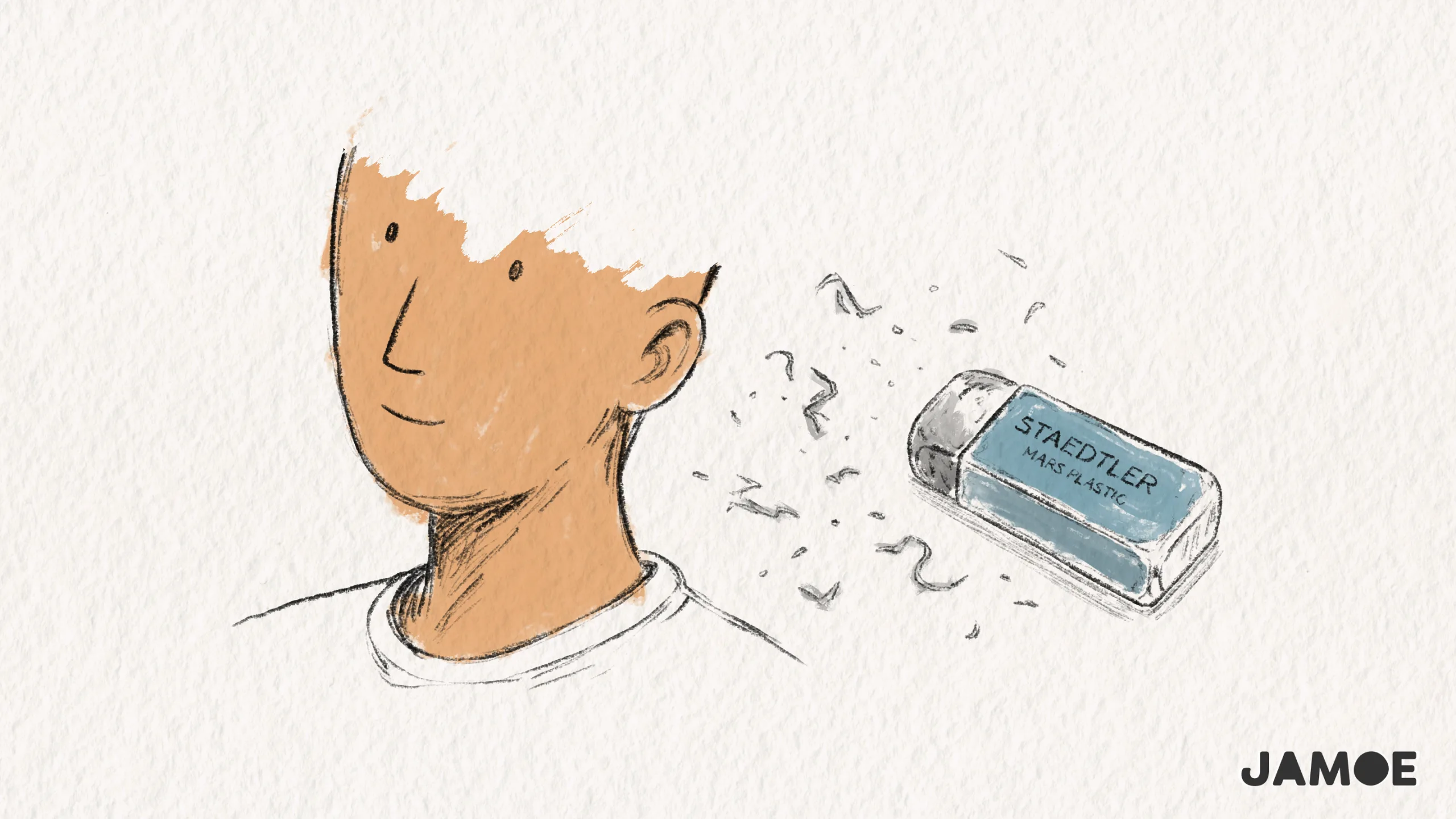
Nietzsche put it more bluntly: 'Forgetfulness is not just a [force of inertia],' he wrote, 'but is rather an active ability to suppress... a little tabula rasa of consciousness to make room for something new... there could be no happiness, cheerfulness, hope, pride, immediacy, without forgetfulness'.1 Funes not only loss the ability to forget. He lost the doorkeeper Nietzsche is describing here, the one whose job is clearing space.
In the extreme, total recall is hellish. Though even the poison from the smallest snake can be troublesome, and the bother that comes from holding onto unhelpful memories can hold us back – like blocking our creative intelligence and keeping us angry and sad.
While these sticking points seem disconnected, they're actually the product of the same underlying failure: the inability to disengage attention from something familiar and redirect it.
So the person stuck on the wrong answer and the one replaying the fight from four years ago in the shower until they win – they're shackled by the same jailer.2
What the fixation costs your creative intelligence
The Einstellung effect shows the cost of this fixation.
In the classic version of the experiment, chess experts were asked to find checkmate in the fewest possible moves. Almost every player found a familiar solution first, a checkmate in five moves, and missed a faster one, a checkmate in three moves, sitting in a completely different corner of the board. Most claimed to still be searching. Eye-tracking told a different story: their gaze stayed locked on the squares linked to the slower solution throughout the trial, rarely drifting to the region where the better move was waiting.3
A follow-up study using eye-tracking on a different chess puzzle found the same split. Among the experts who spotted the familiar-but-inferior move, both those who eventually chose it and those who didn't kept fixating on it, at first. The difference was what happened next: the players who went on to find the optimal move gradually pulled their gaze away from the familiar solution as the trial progressed, while the players who stuck with the familiar move never did. The study implies that the optimal solution seems to depend less on cleverness and more on whether you can physically redirect your own attention once it's locked on.4
Our bias is to switch off when we find a solution, even when we know there's a better one.
This effect also explains why we tend to repeat old mistakes. The mind prefers to be consistent over being correct, so we defend our existing belief rather than revise it.5
What the fixation costs your sanity
Rumination – the technical word for the fight or trauma we can't stop rehearsing – follows the same circularity.
We brood on old grievances, letting them loop, hoping to see a new angle or achieve some closure. While it feels productive and self-satisfying, we're just running the eye-tracking experiment on our own memory, convincing ourselves that we're searching for healthier answers, but never once looking anywhere else.
The neuroscience agrees, as it's been shown that rumination relies on the same neural circuitry used for problem-solving, redirected inwards.
This brooding takes a physical toll. Rehearsing old grudges correlates with measurable spikes in blood pressure, heart rate, and facial tension
All that stirs anger, which narrows your ability to see other, more reasonable, empathetic perspectives. Across a series of studies, people made to feel angry became reliably worse at taking someone else's point of view, whether or not the anger had anything to do with the situation in front of them.6
That padlock of frustration is unfortunate, as the fastest way out of a grudge is usually seeing someone else's point of view.7
Ways of forcing the redirect
With the underlying mechanism being identical, the fix for one can also help undo the other.
Force a second answer
Your attention stalls when you find a solution that's plausible.
A good habit is to insist that a second candidate exists, whether you're debugging a spreadsheet or replaying an old fight.
In the Einstellung experiments, chess players who were able to pull their gaze away from the familiar solution were the ones who went on to find the better move. The instruction to keep looking, even after finding something workable, made all the difference.
Consult yourself as someone else
Solomon's Paradox describes the well-documented phenomenon that people reason far more wisely, flexibly, and generously when they're dealing with other people's problems than their own.8
The main difference is proximity.
We are enwrapped in our own issues. They feel hot and close, while other people's problems are cool and can be viewed with a wide-angle.
Borrowing this, you can change the pronoun when thinking or feeling through a problem: don't ask What could I do next? but what could you do next? or even better what could they do next?
Often we have the wisdom to find a better way; we just need to make a small tweak to access it.
Thank it, then throw it away
Marie Kondo has made a career as a tidying expert, helping people let go of clutter and transform their lives in the process.
I find her method is also excellent at overcoming the Einstellung effect.
When questioning whether an item is serving you, Kondo asks you to question whether the item still serves an important function or sparks joy. If neither is true, it's probably time to let it go.
When letting go, you should thank the item first. At some point, it served you. Being appreciative of that makes discarding the item feel more like closure rather than a loss. That closure is what lets our minds release the item and focus on something else.
'Truly precious memories will never vanish even if you discard the objects associated with them,' Kondo writes. 'No matter how wonderful things used to be, we cannot live in the past. The joy and excitement we feel here and now are more important'.9
For the intangible – feelings, memories, people who've come and gone – the method still works. Simply write whatever it is down on paper, thank it for whatever it once protected or taught you, and then discard it.
How you discard it is up to you. You can choose whatever feels the most cathartic: throwing it in the bin, tearing it up, burning it.
If you're trying to solve a problem, I find thanking the first solution I find and mentally putting it down helpful. That lets my mind relax and be open to other options and avoid falling into the trap that snared the chess players.
Conclusion
Living the life of an unforgetting elephant is less glamorous than one expects. A mind that cannot abstract and will its attention away from the minutia gets stuck thinking that familiar answer is the finished answer – whether that answer is a chess move, a grudge, or a version of ourselves that we've outgrown but keep rehearsing.
The way to overcome this trap is to notice the moment your attention has locked in, and give it somewhere else to go.
For the benefit of our creative intelligence and sanity, we get to make that choice every single day, though most of us never take it. We stay stuck.
Ted Lasso knew this: 'You know what the happiest animal on Earth is? It's a goldfish. Got a ten-second memory. Be a goldfish.' Ted saw the perks of a mind built to let go on schedule, rather than one cursed to remember everything.
So don't get obsessed with the life of an elephant. The goldfish is far happier and healthier. Instead, try to negotiate a compromise between the two. Maybe we can call it living like an elephish: keeping the elephant's memory for what actually matters, and the goldfish's ten seconds for everything else.
- Nietzsche, F. – On the Genealogy of Morals, Second Essay, 1887. ↩︎
- Staircase wit is the name for when you think of the best comeback or response right after you've left a conversation. This concept nicely captures the frustration and humour of those delayed 'ah-ha!' moments. The phrase is a translation of the French expression l'esprit de l'escalier. It was coined by the philosopher Denis Diderot in the 18th century to describe the experience of walking away from a social gathering, being on the stairs, and suddenly realising exactly what you should have said back in the room. In German, a similar idea is referred to as der Treppenwitz. ↩︎
- Bilalić, M., McLeod, P., & Gobet, F. – 'Why good thoughts block better ones: the mechanism of the pernicious Einstellung (set) effect', Cognition, 2008. ↩︎
- Sheridan, H. & Reingold, E.M. – 'The Mechanisms and Boundary Conditions of the Einstellung Effect in Chess: Evidence from Eye Movements', PLoS ONE, 2013. ↩︎
- Research on error repetition finds that ego-protective heuristics push people to defend an existing self-belief rather than revise it, even after repeated mistakes. ↩︎
- Witvliet, C.V.O., Ludwig, T.E., & Vander Laan, K.L. – 'Granting Forgiveness or Harboring Grudges: Implications for Emotion, Physiology, and Health', Psychological Science, 2001. ↩︎
- Yip, J.A. & Schweitzer, M.E. – 'Losing Your Temper and Your Perspective: Anger Reduces Perspective-Taking', Organizational Behavior and Human Decision Processes, 2019. ↩︎
- Grossmann, I. & Kross, E. – 'Exploring Solomon's Paradox: Self-Distancing Eliminates the Self-Other Asymmetry in Wise Reasoning About Close Relationships in Younger and Older Adults', Psychological Science, 2014. ↩︎
- Kondo, M. – The Life-Changing Magic of Tidying Up, 2014. ↩︎