Setup the tools in your life to enrich, not subtract.
Most tools will stay in their drawer, but modern tools are needier.
Especially our phones.
By default, they don’t want to live peacefully in our pockets. They want to be picked up, played with, and will whine with beeps and buzzes until we heed their howling.
The operative phrase here is by default. It doesn’t have to be this way.
We can, with a few toggles and tricks, turn down the noise, and reclaim some headspace.
Make no mistake, the cost of not doing so is greater than a few seconds here and there.
There is an anxiety that hums in the background. The hum is a sign of the fear that our calm, focus, or repose could be shattered at any moment.
After dabbling, I wanted to share my headspace reclamation recipes with you. Like all recipes, I hope they inspire you to create your own, and add a few personal touches.
In order of effort to implement from lowest to highest:
- Phone on silent by default – flick the switch. The noises where novel when I first got my phone, but now they’re just a dopamine hit with little payoff.
- Set all phone and computer notification to be turned off by default – whenever a new app installs, I never allow notifications. If and only if I find myself wishing they were on do I then activate them. So far, only two such apps have made the cut: the messaging app I use with my close friends and family, and a live chat app that clients use to receive support.
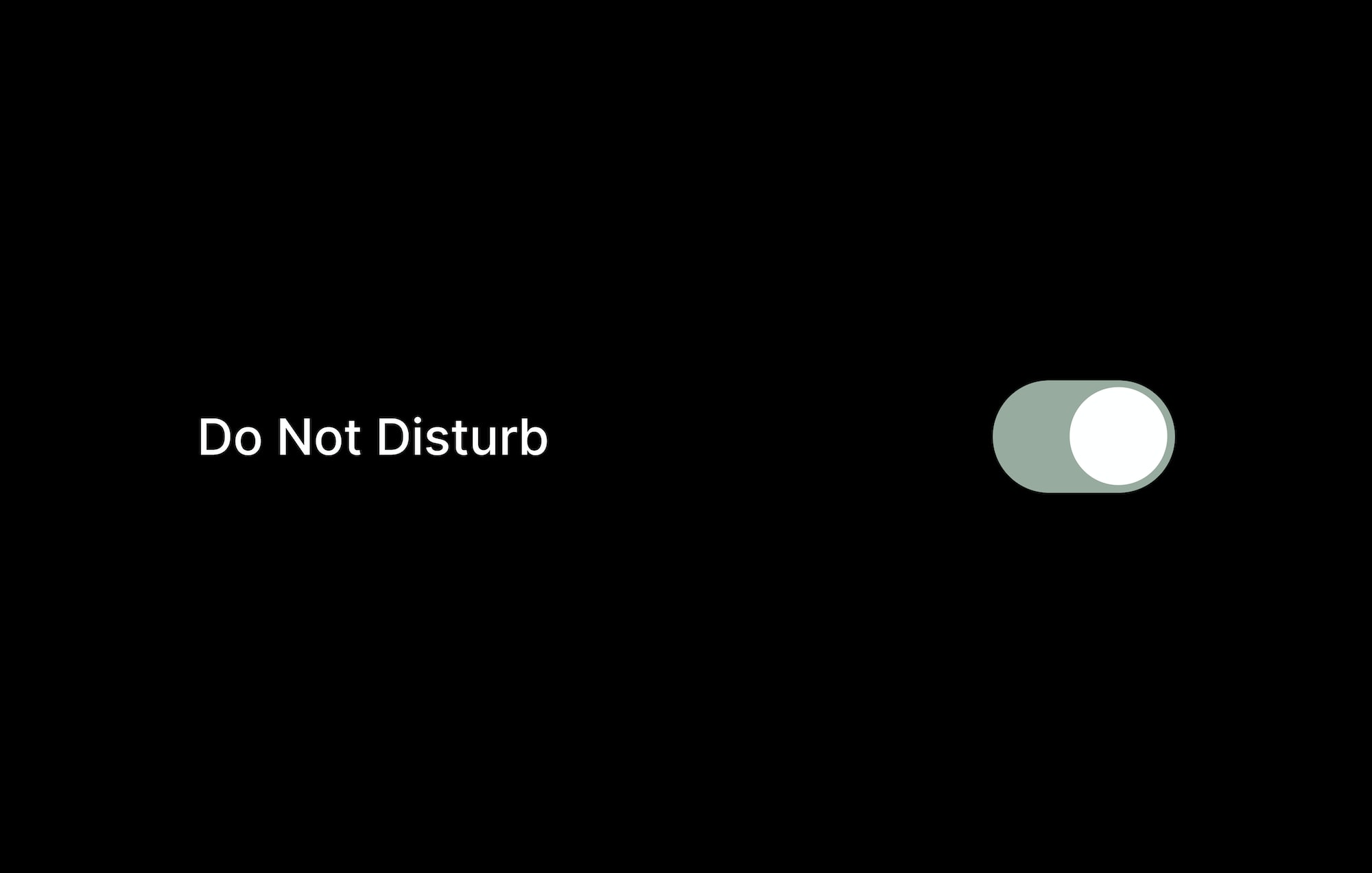
- Set a Do Not Disturb schedule – permit yourself to be off-the-clock. Outside of the hours of 8am – 8pm, my phone goes into Do Not Disturb. If you're one of my contacts and ring my phone twice, however, you’ll get through, and those that might contact me with urgent news know this.
- Phone out of the bedroom – this one is hard, especially if you live in a studio. The objective is to put it out of sight, so a drawer will do. If you need its alarm function, getting a dedicated clock is an inexpensive and rewarding investment.
- Screen time limits – YouTube knows me too well. I used to spiral into YouTube rabbit holes, and hours would pass. Part of that is because I’m weak, though it's also because the algorithms are strong, and honed to compel me to click. Screen limits do two things i) with only 15 minutes a day, I focus on getting the most value from what I consume, which makes me have a bias for things that will enrich my life; ii) when the limit it up, it disrupts me. I can pause, and ask ‘Do I truly want to watch this video?’. Normally the answer is no, and I then make a more conscious decision for how I want to spend my time.
The only thing now that beeps at me is the washing machine.
Do you have others? Feel free to reply, as I’d love to hear your tricks for calming the noise, whether it be on your phone or otherwise.
Mastering my mind is a never-ending task, which is why I’ve been exploring mindfulness through meditation, tai chi, yoga, and squaring these with science.
After all, we are the thoughts we pay attention to, so a happy mind is a happy life.
Taken even further, one can look to Lao Tzu who said, ‘Watch your thoughts, they become your words; watch your words, they become your actions; watch your actions, they become your habits; watch your habits, they become your character; watch your character, it becomes your destiny.’
I’d rather my destiny be mine, not my phone’s.
Stay curious,
Jamie
P.S. Ever wondered which apps make you the happiest, or the most miserable?
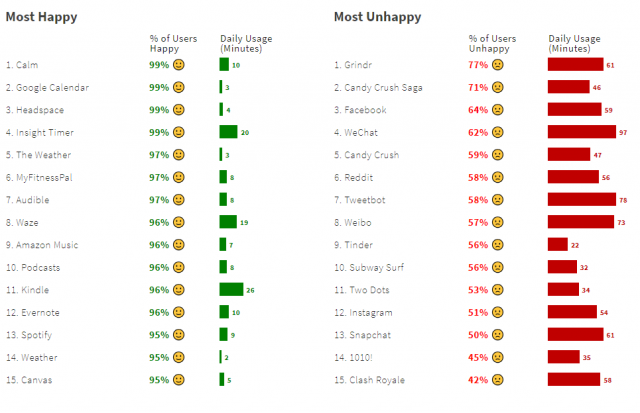
A study by the Centre for Humane Technology pooled data from 200,000 iPhone users. I found the chart below the most fascinating, but you can see the full article here.
Calm, a brilliant meditation app, was the happiest.
The unhappiest was Grindr, a hook-up app (this is not family-friendly, so don’t Google it in polite company).
A theme running through the unhappy apps is prolonged use. They offer an initial high, but then we grow sick, and are reminded of the underlying problem we were trying to solve by using that app.
It’s like eating chocolate when we’re hungry. Delicious, but after an entire bar, we feel sick, and want some “real-food”.
If I had to presume:
- Grindr and Tinder = loneliness?
- Candy Crush and Clash Royale = feeling lost?
- Facebook, Instagram, Snapchat = avoiding FOMO?